

Creator Economy Trends

Non-Game Apps Beat Games: A $82B Creator Opening

Built by Foundry
July 6, 2026
Share
Non-Game Apps Beat Games: A $82B Creator Opening

Get Creator Revenue Insights

How creators are turning audiences into subscription businesses
Share
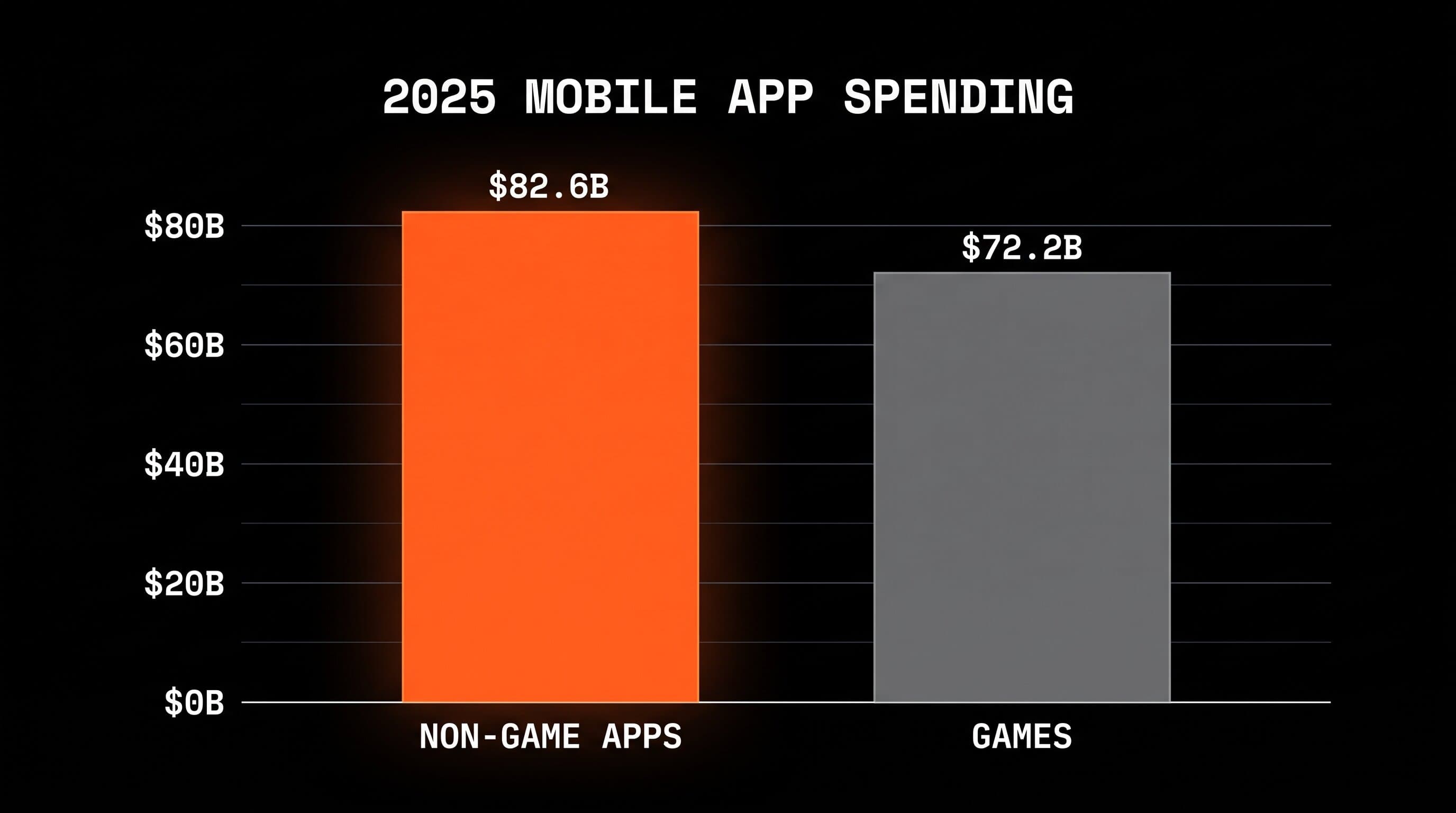
For the first time, people spent more money inside non-game apps than inside mobile games. In 2025, non-game apps pulled in $82.6 billion against games' $72.2 billion, and almost all of that non-game money came from subscriptions. This is the biggest structural shift in the app economy since the App Store opened, and it points straight at content creators. The categories driving the crossover are the ones creators already own: fitness, wellness, education, finance, cooking, and language. If you have an audience in any of those niches, the money just moved to the exact product you are best positioned to build. Key Takeaways:
  • Non-game apps out-earned mobile games for the first time in 2025: $82.6B vs $72.2B, per Appfigures data reported by TechCrunch.
  • Non-game spending grew 33.9% year over year while games grew about 10%. The gap is widening, not closing.
  • Roughly 96% of App Store and Google Play spending now comes from subscriptions, not one-time purchases.
  • The fastest-growing non-game categories (health, fitness, education, finance) are the ones creators dominate.
  • A creator with a $9.99/month app and 4,000 subscribers starts each month at $40K in recurring revenue before posting anything new.
In 2025, non-game apps generated $82.6 billion in consumer spending versus $72.2 billion for games, the first year non-game apps took the top spot. Total mobile app spending hit $155.8 billion, up 21.6% year over year, according to Appfigures data reported by TechCrunch in January 2026. For a decade, games carried the App Store. They drove the downloads, the revenue, and the headlines. That era is over. Non-game apps grew 33.9% last year. Games grew roughly 10%. In the United States alone, non-game spending climbed 26.8% to $33.6 billion while games rose 6.8%. The engine behind that reversal is the subscription. Almost 96% of app store spending now comes from recurring subscriptions rather than one-time downloads or in-app purchases. People stopped buying apps once and started renting them monthly. And the apps they rent are the ones that show up every day to help them cook, train, budget, learn, and sleep. What is a non-game subscription app? It is an app that charges a recurring monthly or annual fee for ongoing access to content, coaching, tracking, or tools, in a category outside gaming: health and fitness, education, productivity, finance, lifestyle, or entertainment. Non-game apps won because subscriptions compound and one-time purchases do not. A game sells you a $4.99 unlock once. A fitness app charges you $12.99 every month for two years. Over the life of one user, the subscription app collects 60 times more, and it does it on autopilot. Games also fight a retention problem that subscription apps sidestep. Players finish a game, get bored, and churn. But someone using a habit tracker, a workout app, or a budgeting tool has no finish line. They come back because the job is never done. That is why health and fitness was one of the fastest-growing categories in 2025, and why education and finance apps kept compounding. The average iOS subscription now runs $7.93 a month, up 4.5% from the prior year, per public app-market reporting. Multiply a modest price by high retention across millions of users and you get an $82 billion category that did not exist at this scale five years ago. We broke down the mechanics of this in why the subscription app squeeze still favors creators.
Bar chart comparing 2025 mobile consumer spending: non-game apps at 82.6 billion dollars versus games at 72.2 billion dollars
The growth is concentrated in the categories creators already have authority in. Health and fitness apps posted double-digit growth again in 2025. Education kept climbing as people paid to learn skills on their phones. Finance apps grew as budgeting and investing went mobile-first. These are not abstract markets. They are the exact niches where creators already have audiences, trust, and daily attention. Here is how the money now splits across the app economy, and where creators fit.
App category2025 directionCreator advantage
Health & FitnessGrowing fastTrainers, coaches, wellness creators
EducationGrowingTeachers, tutorials, skill creators
FinanceGrowingMoney and investing creators
Lifestyle & FoodGrowingChefs, recipe, and home creators
Mobile GamesSlow growthNo creator angle
A game studio needs artists, engineers, and a hit-or-miss launch. A creator with 80,000 engaged followers in a niche already has the two things that are hardest to buy: distribution and trust. The product is the only missing piece. That is the whole thesis behind why fitness creators dominate the app economy, and it now extends to every non-game category. It means the most valuable thing you can build is no longer more content. It is a product your audience pays for monthly. The $82 billion non-game category is proof that consumers will pay recurring fees for the exact expertise creators give away for free every day. Think about the gap. A cooking creator posts a recipe to 500,000 followers, earns a one-time brand payment, and starts the next week at zero. A cooking creator with a $6.99/month recipe app and 5,000 subscribers starts the next week at $35,000 in recurring revenue, whether they posted or not. Same audience. Completely different business. This is the difference between a creator and a founder. A creator rents attention from an algorithm and monetizes it once. A founder owns a product that shows up in App Store search, gets discovered by people who have never seen the creator's content, and bills every month on its own. We covered the full argument in you built an audience, now build a company. A brand deal is a bet on a single moment. You post, you collect, the money stops. The $82 billion moving through non-game subscription apps is the opposite. It is money that arrives every month from the same customers, then keeps arriving after the creator stops posting entirely. Run the comparison and the gap is not close.
Income modelPays onceCompounds monthlyGrows via App StoreSells as an asset
Brand dealYesNoNoNo
Affiliate linkYesNoNoNo
One-time courseYesNoNoLow
Subscription appNoYesYesYes, 3x to 8x ARR
A smartphone on a dark surface showing a subscription app, lit with a warm orange accent, representing recurring creator revenue
The app also does something no brand deal can: it acquires customers who never saw the creator's content. App Store search sends installs to whoever ranks for "macro tracker" or "guided breathwork," regardless of follower count. That is a growth channel most creators are ignoring, and it is covered in depth in why your next 10K fans won't come from social media. The path is simple to describe and hard to do alone: turn your specific expertise into a subscription app, ship it to the App Store, and let recurring revenue compound. The hard part is the build, submission, payments, retention, and updates, which is exactly the part most creators do not want to learn. Here is the sequence that works:
  • Pick the one thing your audience already asks you for constantly.
  • Turn that into a focused app, not a bloated platform. The best creator apps do one job well.
  • Price it as a monthly subscription, not a one-time purchase, so it compounds.
  • Ship it to the App Store and optimize for search, not just your existing followers.
  • Keep it maintained and updated so retention holds and revenue grows.
Creators who try to do all of that with vibe-coding tools stall at step 4, because a prototype is not an App Store product. The winners partner with a team that handles the build and the ongoing app care so they can keep doing what they are good at: showing up for their audience. The window on this $82 billion shift is open now, while most creators are still chasing the next brand deal. Want to turn your expertise into an app? We build custom apps for creators. $0 upfront, three-week delivery, we handle all the tech forever.
Let's Build →
Yes. Consumers spent $82.6 billion in non-game apps versus $72.2 billion in mobile games in 2025, the first year non-game apps took the lead, according to Appfigures data reported by TechCrunch. Non-game spending grew 33.9% while games grew about 10%. Subscriptions compound. A one-time purchase pays once, while a subscription bills the same user every month for as long as they stay. Roughly 96% of App Store and Google Play spending now comes from subscriptions, and high-retention categories like fitness, education, and finance keep users paying for years. Health and fitness, education, finance, and food and lifestyle are the fastest-growing non-game categories, and they map directly onto the niches where creators already have audiences and trust. A creator with authority in one of these areas has the distribution most app startups spend millions to acquire. Most agencies charge $50K to $200K upfront. Built by Foundry charges $0 upfront and takes a revenue share instead, so the creator only pays when the app earns. We build, launch, and run the app, including App Store submission and ongoing updates. Most development shops take six to twelve months. Built by Foundry ships to the App Store in about three weeks, then keeps optimizing pricing, retention, and features after launch so the recurring revenue compounds.

Creator app strategy

Want us to review your creator business?

Apply for a Foundry Creator App Review. We'll tell you whether there is a real app opportunity hiding in your audience.

Non-Game Apps Beat Games: A $82B Creator Opening