

5 Gumroad Alternatives That Build Recurring Revenue

5 Gumroad Alternatives That Build Recurring Revenue

Foundry
April 8, 2026
Key Takeaways:
  • Gumroad charges 10% + $0.50 per sale and doesn't refund its fee on refunds, costing high-volume creators thousands per year
  • Stan Store ($29/mo flat) and Payhip (5% per sale) are the strongest direct Gumroad replacements for digital product sales
  • Lemon Squeezy handles global tax compliance as a Merchant of Record, saving international sellers from VAT headaches
  • Podia bundles courses, downloads, community, and email marketing for $39/mo with zero transaction fees
  • The real move isn't switching storefronts. It's switching models: subscription apps generate 3x to 5x the lifetime revenue of one-time digital products

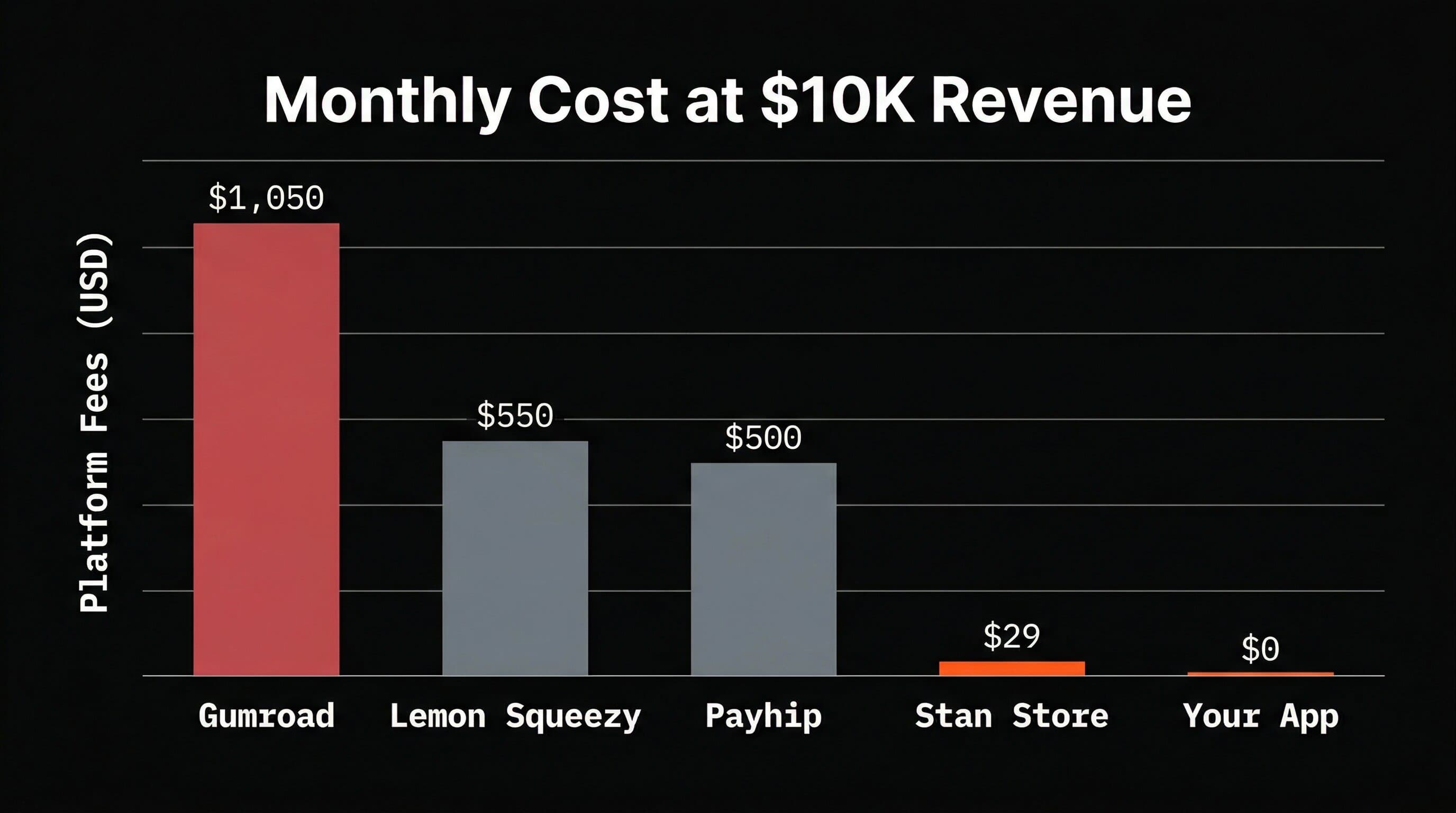
Looking for Gumroad alternatives? You're not alone. Since Gumroad restructured its pricing to a flat 10% cut of every sale (plus $0.50 per transaction), creators doing any real volume have started doing the math. And the math isn't pretty. Sell $10,000 worth of digital products in a month and Gumroad keeps $1,000+. That's a team member's salary. That's ad spend. That's money you earned that's going to a platform that gave you a checkout page. We broke down Gumroad's strengths and limits in our full Gumroad review. This post is for creators who've read the fine print and are ready to compare options. Three problems keep coming up. The fee structure doesn't scale. At 10% + $0.50 per transaction, Gumroad is cheap when you're selling $50/month. At $5,000/month, you're paying $550 in platform fees alone. At $20,000/month, it's over $2,000. Flat-rate monthly plans from competitors start looking very different at that point. No refund on platform fees. When a customer gets a refund, Gumroad keeps its 10% cut. So a $100 product refund costs you $10.50 in fees you never get back. On a digital product with a 5% to 10% refund rate, that adds up fast. One-time sales are a ceiling, not a foundation. Gumroad is built for transactions: someone buys your PDF, template, or preset pack, and you get paid once. The platform has basic membership features, but they're an afterthought. If you want recurring revenue (and you do), Gumroad's architecture fights you at every step.
Monthly platform fees compared at $10K revenue: Gumroad costs $1,050 while Stan Store costs just $29
Here's how five alternatives stack up on the metrics that matter most.
PlatformMonthly FeeTransaction FeeBest ForRecurring Revenue
Stan Store$29/mo0%Social media creatorsBasic memberships
PayhipFree5% per saleBudget-conscious sellersMemberships available
Lemon SqueezyFree5% + $0.50International sellersSubscriptions + SaaS
Podia$39/mo0%Course creatorsCourses + community
Your own app$0 upfrontRevenue shareCreators with 50K+ followersFull subscription business
Now let's break each one down. Best for: Social media creators who sell from their bio link. Stan Store is built for creators who drive traffic from TikTok, Instagram, and YouTube. At $29/month with zero transaction fees, the economics flip in your favor fast. If you sell more than $290/month on Gumroad ($290 x 10% = $29), Stan Store is already cheaper. What it does well:
  • Link-in-bio storefront that actually converts
  • AutoDM features for Instagram and TikTok
  • Digital products, courses, and booking pages in one place
  • Flat monthly fee means you keep everything you earn
Where it falls short:
  • Limited customization and branding options
  • No native mobile app for your audience
  • Memberships are basic; not built for serious subscription businesses
  • You're still renting shelf space on someone else's platform
Who should use it: Creators doing $300+ per month in digital product sales who want to stop paying Gumroad's percentage. It's the fastest swap and requires almost no learning curve. Best for: Creators who want to minimize fees without a monthly commitment. Payhip charges 5% per sale on its free plan, half of what Gumroad takes. It supports digital downloads, online courses, coaching, memberships, and even physical products. Over 150,000 sellers use it, and the feature set is surprisingly deep for a free platform. What it does well:
  • 5% transaction fee (vs. Gumroad's 10%)
  • EU VAT handling included
  • Affiliate marketing tools built in
  • Course builder and membership features included on every plan
Where it falls short:
  • Less name recognition than Gumroad (smaller marketplace)
  • Design and storefront customization is limited
  • Still fundamentally a transaction platform
  • Your revenue depends on you driving traffic to someone else's checkout page
Who should use it: Creators who sell occasionally and don't want a monthly fee, but are tired of Gumroad's 10% cut. The savings are real: on $5,000/month in sales, you'd save $250/month switching from Gumroad to Payhip. Best for: International creators and anyone selling subscriptions or software. Lemon Squeezy operates as a Merchant of Record, meaning it handles global sales tax, VAT, and GST on your behalf. If you sell to customers in the EU, UK, or Australia, this alone can save you hours of compliance work and thousands in accounting fees. What it does well:
  • Full Merchant of Record: handles global tax, billing, and compliance
  • 5% + $0.50 per transaction (competitive with Payhip)
  • Strong subscription and SaaS billing tools
  • License key management for software products
Where it falls short:
  • No marketplace for organic discovery (you drive all traffic)
  • Digital-only; no physical product support
  • Higher per-transaction fee than Payhip for small sales
  • The platform is built more for developers and SaaS than for content creators
Who should use it: Creators selling internationally who don't want to deal with VAT registration, or anyone selling software, subscriptions, or digital tools where license management matters. Best for: Course creators who want an all-in-one platform without transaction fees. Podia bundles courses, digital downloads, community, and email marketing for $39/month with zero transaction fees. If you're currently paying Gumroad 10% on course sales and using a separate email tool and community platform, Podia might consolidate three bills into one. What it does well:
  • Zero transaction fees on all plans
  • Course builder, community, email marketing, and downloads in one platform
  • Clean, modern interface that's easy for non-technical creators
  • Affiliate marketing and embeds included
Where it falls short:
  • Monthly fee regardless of sales volume
  • No mobile app; everything runs in a browser
  • Community features are basic compared to Circle or Skool
  • You're still building on rented land
Who should use it: Course creators doing $400+/month on Gumroad who also pay separately for email marketing or community tools. The all-in-one approach saves money and simplifies operations.
One-time sales versus recurring subscription revenue: a single receipt versus a compounding growth curve
Here's the question none of the platforms above can answer: what happens when you stop selling products and start owning a business? Every alternative on this list is a better checkout page. Some are cheaper. Some have more features. But they all share the same structural limit: you're selling individual transactions on someone else's platform, and your entire business disappears if that platform changes its terms. The creators earning the most aren't swapping storefronts. They're building subscription apps. Kayla Itsines started selling $52 workout PDFs. She built the Sweat app and sold it for $400M. Bobby Parrish went from recipe videos to a 138K-rated food app. The pattern is the same: one-time product sales hit a ceiling, subscription apps break through it. Here's how the math works. 500 subscribers at $9.99/month is $4,995/month in recurring revenue, every single month, without a single new sale. You own the app. You own the data. Your users find you through the App Store, not just your social media. And the revenue compounds instead of resetting to zero.
ModelMonthly Revenue (500 customers)Annual RevenueYou Own It?
Gumroad (one-time $29 ebook)$0 after initial salesDepends on new trafficNo
Stan Store (monthly membership $9.99)~$4,700 after fees~$56KNo
Your own app ($9.99/mo subscription)~$5,000~$60K+ growingYes
The difference isn't just revenue. An app gives you a content engine (every user interaction is a post), deeper fan engagement (daily active users, not one-time buyers), and a growth channel (App Store discovery) that no storefront offers. That's what we call the Creator Value Triangle. Gumroad still works for a specific type of creator:
  • You sell fewer than 5 products and make under $300/month
  • You don't want a monthly fee under any circumstances
  • Your products are one-time purchases and you have no plans to build subscriptions
  • You value the Gumroad Discover marketplace for organic sales
If that's you, Gumroad's 10% is the cost of simplicity, and that's a fair trade. But if you're reading an article about Gumroad alternatives, you've probably already outgrown it. Payhip's free plan charges 5% per sale with no monthly fee, making it the cheapest direct replacement. For creators doing over $400/month, Stan Store's flat $29/month with zero transaction fees becomes cheaper than any percentage-based model. Yes. Most platforms (Stan Store, Payhip, Podia) let you import digital products manually. You'll need to re-upload files and recreate product listings. Customer email lists can usually be exported from Gumroad and imported into your new platform. For very small sellers (under $300/month), the simplicity is worth the cost. Above that threshold, flat-fee platforms save you money every month. At $10,000/month, Gumroad's fees cost $1,050 versus Stan Store's flat $29. Review our complete Gumroad breakdown for the full analysis. Building a subscription app. One-time product sales require constant new traffic. Subscription apps compound monthly, earn while you sleep, and attract new users through App Store discovery. Creators with 50K+ engaged followers can realistically build $5,000 to $50,000/month in recurring revenue. Your next sale shouldn't be your best sale. Every creator on this list is one decision away from recurring revenue. The question isn't which storefront to use. It's whether you want to keep selling, or start owning.
Let's Build →

Get Creator Revenue Insights

How creators are turning audiences into subscription businesses

You might also enjoy...

5 Gumroad Alternatives That Build Recurring Revenue