
Platform Reviews

FlutterFlow Review 2026: Can Creators Ship a Real App?

Foundry
May 30, 2026
Share
FlutterFlow Review 2026: Can Creators Ship a Real App?

Get Creator Revenue Insights

How creators are turning audiences into subscription businesses
Share
Our verdict: FlutterFlow is the most mobile-serious no-code builder on the market in 2026, and the only one that actually puts a native binary in your hands. It is also a tool, not a team. It will get a creator to a runnable iOS build. It will not get a creator to a paying audience. Rating: 3.5/5. FlutterFlow is the rare AI and visual builder that admits the App Store exists. While Bolt.new, Lovable, and Replit stop at a web app on a public URL, FlutterFlow compiles a real Flutter project into iOS and Android binaries you can actually submit. For a creator with 50K plus followers, that single difference matters more than any other feature. But shipping a binary is step one. Getting approved, getting installed, getting paid, and staying installed are steps two through ten. That is where the gap between "no-code builder" and "real creator business" lives. Key Takeaways:
  • FlutterFlow is a visual builder for Flutter, Google's cross-platform framework, founded in 2020 by two ex-Google engineers.
  • It generates real Dart code that compiles to native iOS and Android, not a web app pretending to be one.
  • Pricing runs from a free tier to $30 per month (Standard) and $70 per month (Pro), with Teams and Enterprise plans above that.
  • Backend defaults to Firebase, with Supabase and custom API support.
  • The build it gives you is real. The submission, the App Store assets, the paywall optimization, the push lifecycle, and the next year of code maintenance are not in the box.
CategoryScore
Speed from idea to working mobile build4/5
Quality of generated Dart code4/5
Visual builder experience4/5
Pricing transparency4/5
Native iOS and Android output4/5
Backend depth (Firebase, Supabase)3.5/5
App Store submission readiness2.5/5
Long-term maintainability3/5
Operational tail (push, paywall, growth)1/5
Overall3.5/5
FlutterFlow earns a higher overall score than the in-browser builders because it actually produces mobile code. It loses points where every creator subscription business lives or dies: store submission, App Store Optimization, paywall iteration, and the year of maintenance after launch. FlutterFlow is a visual development platform that lets you design, build, and export native mobile applications without writing code line by line. You drag components onto a canvas, wire up data and logic, and the platform generates a real Flutter project in Dart that you can run on iOS, Android, and the web from a single codebase. The company was founded in 2020 by Abel Mengistu and Alex Greaves, two former Google engineers who built the product after watching how slow most teams were at turning Figma files into shipped mobile apps. By 2024, FlutterFlow was reporting more than one million users on its platform and had raised a Series A led by GV (the venture arm formerly known as Google Ventures), as reported by TechCrunch. The product sits in a different category than Lovable, Bolt, or Replit. Those tools ship web apps. FlutterFlow ships mobile apps. That single architectural choice is what makes it relevant to creators in a way the others are not.
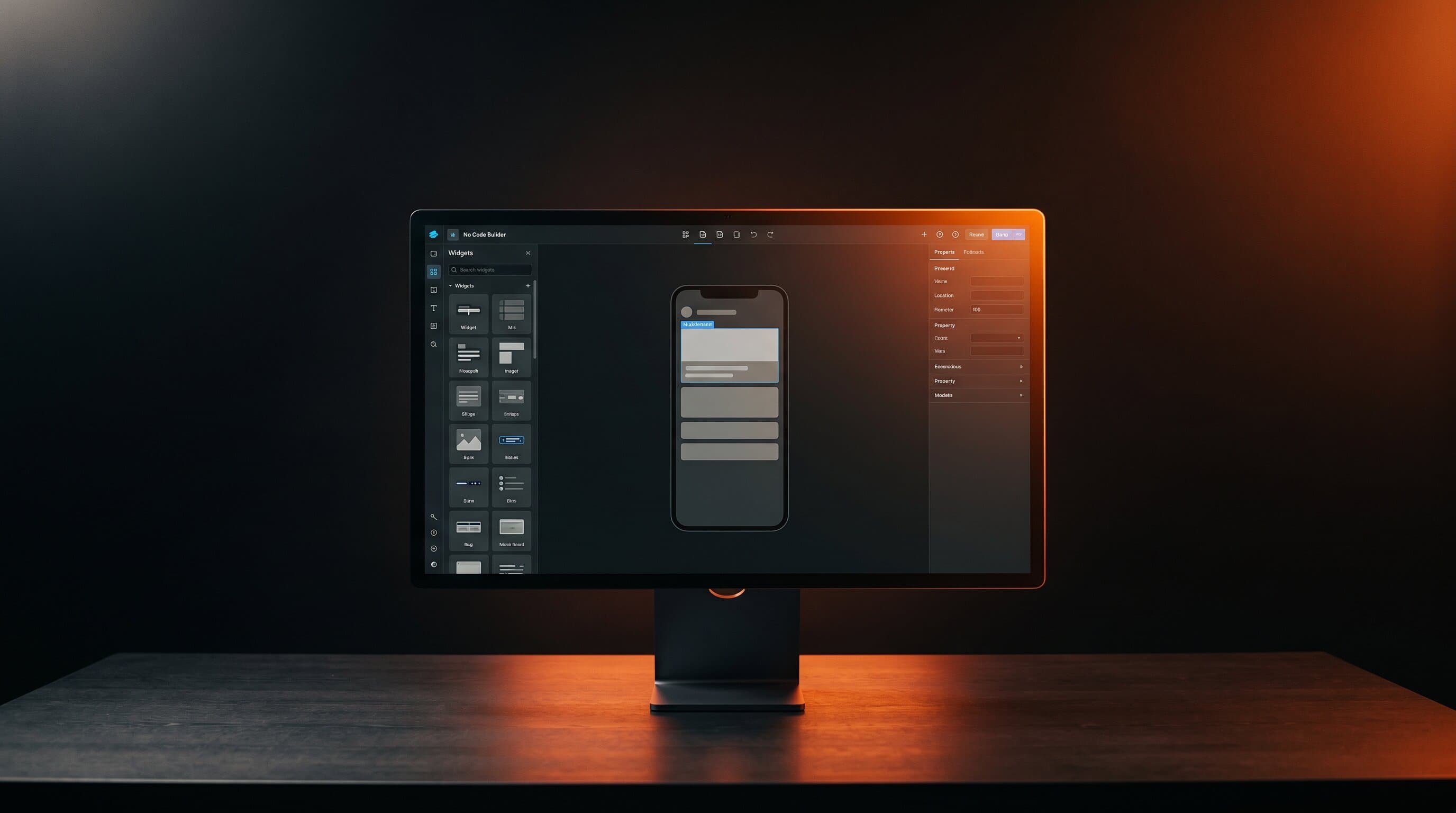
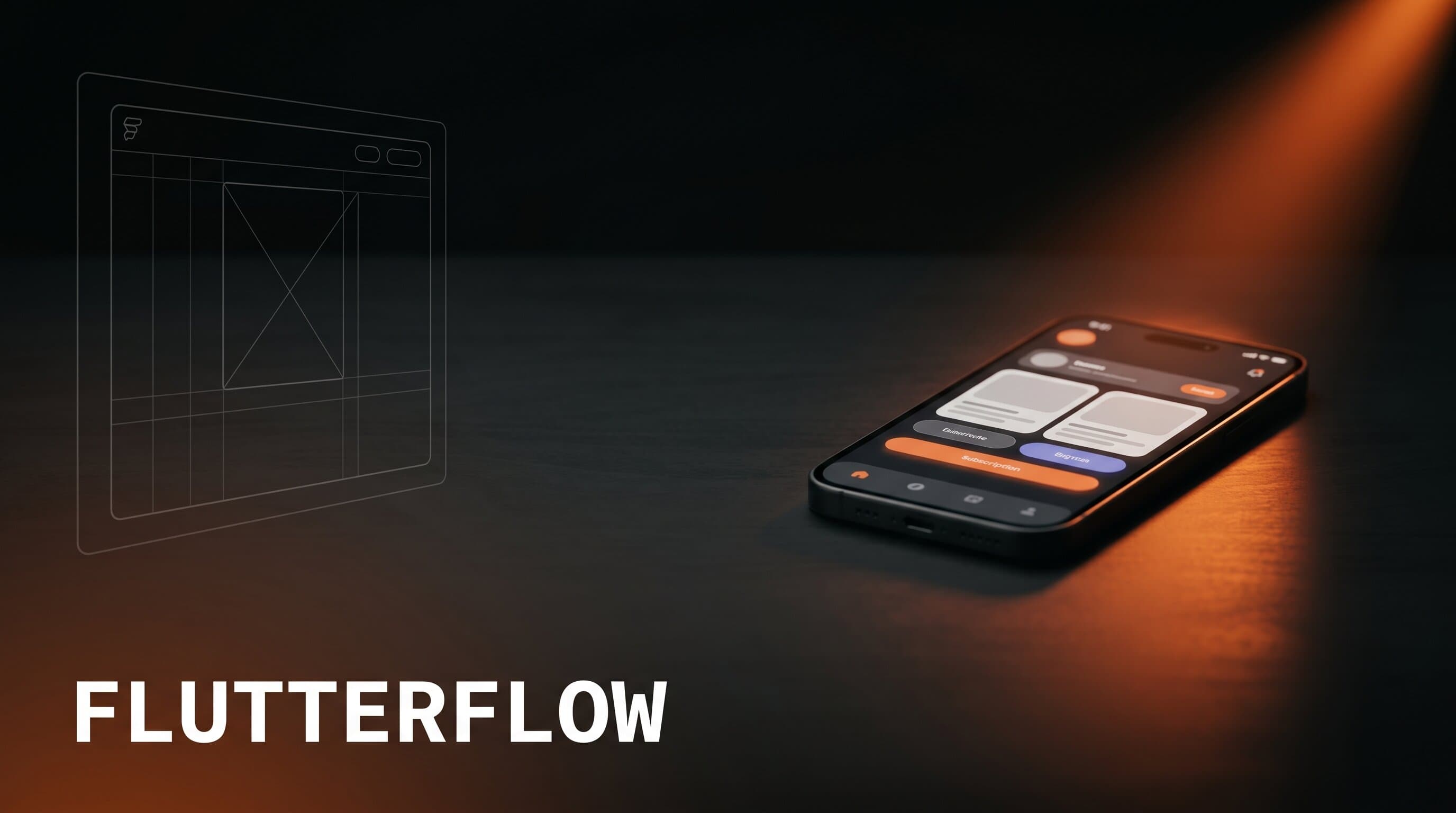
FlutterFlow visual editor with canvas, component tree, and live device preview
The platform is four products in a trench coat. A visual builder. You design screens by dragging widgets onto a canvas. Buttons, lists, forms, navigation, theming. The canvas mirrors what the app will look like on a real device. A data and logic layer. You connect Firebase or Supabase as your backend, define collections and queries, and wire up actions like "on button tap, write document, navigate to next screen." You can also call any REST API. A code generator. Behind the visual layer, FlutterFlow writes real Dart and Flutter code. You can read it, export it, open it in Cursor or VS Code, and add custom code blocks the visual builder cannot express. A build pipeline. With one click, FlutterFlow produces a TestFlight build for iOS, an internal track for Android, or a deployed web preview. You point it at your Apple Developer and Google Play accounts, and the platform handles the certificate and provisioning work. The combination is the closest thing on the market to "Figma plus a real Flutter compiler." For a creator who has been burned by web-only AI builders, that is a meaningful upgrade. FlutterFlow uses straightforward seat-based pricing rather than the token meters that make Bolt.new pricing hard to predict.
PlanMonthly PriceBest For
Free$0Trying it out, single-screen projects
Standard$30Indie creators, side projects, one app
Pro$70Real product work, code export, custom logic
Teams$70/userSmall teams collaborating on a shared project
EnterpriseCustomAgencies, multi-app accounts, SSO
The Pro tier is the realistic starting line for a creator building anything beyond a demo. Code export, deeper integrations, and the ability to add custom functions live behind that paywall. Annual billing knocks the price down further. Compare that to hiring a Flutter developer at $80 to $150 an hour or an agency at $50K to $200K, and FlutterFlow looks like a deal. It is. The catch is that the bill is for software, not for someone who ships. Three things separate FlutterFlow from every other no-code or AI builder pitched at creators. 1. It outputs real mobile code. Flutter is a serious framework, used in production by BMW, Toyota, eBay, and others. The Dart code FlutterFlow generates is not a sandboxed prototype. It is a project a Flutter engineer can open, extend, and ship. This is the single biggest reason to pick it over the in-browser builders. 2. It has a real backend story. Firebase integration is first-class. Supabase, REST APIs, GraphQL, and custom functions are all reachable. For creator apps that need user accounts, content storage, push notifications, and analytics, FlutterFlow gives you the wiring without rolling your own. 3. It lets you escape. The Pro plan includes code export. If you outgrow the visual builder, you can take the code with you, hire a real Flutter developer, and keep building. That escape hatch is what separates FlutterFlow from no-code traps like Bubble or Glide, where the code is the platform's property. For a designer or a technical founder who already understands what an app needs, FlutterFlow can cut weeks off a prototype. The wall is the same wall every builder hits when a creator tries to use it solo. It just shows up further down the road. App Store submission is a project, not a button. FlutterFlow can produce an iOS build. It cannot fill out App Store Connect, write the listing copy, generate the screenshots, configure In-App Purchase products, pass App Review, or respond when Apple rejects you for Guideline 4.3 (Design Spam) or any of the other 200 sub-rules. We have watched creators sit on a finished FlutterFlow build for six weeks because none of the post-build work was inside the tool. The paywall is not in the box. Creator apps live or die on free trial conversion, annual versus monthly pricing, and price localization. FlutterFlow gives you a screen where you can drop a "subscribe" button. It does not give you A/B testing infrastructure, RevenueCat wiring tuned for your category, or a price-test backlog. The economics of annual versus monthly subscriptions are a separate problem the tool cannot solve. Push, lifecycle, and retention are missing. Real subscription apps run weekly push campaigns, lifecycle emails, win-back flows, and onboarding experiments. FlutterFlow can technically connect to Firebase Cloud Messaging. It does not write the campaigns or pick the moments. As we covered in The Content Treadmill Is Killing Creators, the operating layer is where creator apps win or lose. The next year of maintenance is your problem. SDKs deprecate. iOS releases break things. Firebase changes pricing. RevenueCat ships breaking updates. A FlutterFlow project a year after launch needs the same care as any other mobile codebase. Most creators who pick FlutterFlow assume "no-code" means "no maintenance." It does not. This is the same pattern we documented in the vibe coding trap. The tool gets you 60 percent of the way. The 40 percent that ships, monetizes, and grows is still missing. Yes, and that yes is doing a lot of work. Technically, a FlutterFlow Pro project plus an Apple Developer account ($99 per year) plus a Google Play Console account ($25 one-time) plus a few hours of certificate work plus a few more hours of App Store Connect setup will get you to a submission. People do it. Some get through review on the first try. What rarely happens solo is the second half of the story. Real ASO. A paywall tuned for your audience. Retention loops that hit 12-week LTV targets. Onboarding that converts above 30 percent free trial start rate. Updates every two to four weeks because the App Store rewards velocity. Marketing assets and seasonal promotions. Reviews and response. A creator can ship a FlutterFlow build. A creator on their own almost never runs the business after launch the way successful creator apps run theirs, which is why so few solo FlutterFlow apps cross meaningful revenue. The four products get lumped together. They should not be. Here is the honest comparison.
ToolPrimary OutputMobile NativeApp Store Ready
FlutterFlowNative iOS and Android (Flutter)YesBuild yes, submission no
Bolt.newWeb app (React, Next.js, Vue)NoNo
LovableWeb app (React, Supabase)NoNo
ReplitWeb app, scripts, agentsNoNo
Built by FoundryNative iOS on the App Store, launched and runYesYes
If you must use one of the four no-code or AI builders today, pick FlutterFlow for mobile and one of the others only for a web prototype. For more on why a web app is not an app, see Lovable vs Custom Dev: What Creators Should Know. FlutterFlow is the right call for:
  • Technical founders who know what they want to build and want to skip the boilerplate
  • Designers who already understand mobile patterns and want to prototype in real code
  • Small product teams testing an internal app or a B2B mobile tool
  • Flutter developers who want to use the visual builder as a starter and then take over the code
FlutterFlow is the wrong call for:
  • Content creators with 50K plus followers who need a real subscription business, not a project
  • Anyone who has never submitted an app and underestimates how much work that is
  • Anyone who expects the tool to optimize their paywall, run their push campaigns, or grow ASO
  • Anyone who plans to ship once and then go back to making content
If you are in the second list, this is the gap our entire company was built to close. Think of FlutterFlow the way serious teams think of Figma. It is a powerful tool in the hands of someone who already knows the craft. It is not a substitute for the craft itself. For creators who eventually build serious app businesses, the pattern is almost never "I used a no-code tool and now I have a $1M ARR app." The pattern is the one we covered in our profile of Kayla Itsines and the Sweat app's $400M exit: a real product team, ongoing investment in the paywall and content engine, App Store presence treated as a growth channel, and years of compounding work. FlutterFlow can sit inside that team's stack. It cannot replace the team. To learn more about how Foundry builds, ships, and runs creator apps end to end, see how we work and our framework on the content treadmill. Yes. FlutterFlow generates a Flutter project that compiles to a native iOS binary you can submit to the App Store. This is the biggest difference between FlutterFlow and web-only AI builders like Lovable, Bolt.new, and Replit. The catch is that FlutterFlow stops at the binary. Submitting, optimizing, monetizing, and maintaining the app is still your job. FlutterFlow has a free tier, a Standard plan at $30 per month, and a Pro plan at $70 per month that unlocks code export and custom code. Teams pricing is $70 per user per month, and Enterprise is custom. Annual billing offers a meaningful discount. You will also need an Apple Developer account at $99 per year and a Google Play Console account at $25 to actually ship. For creator apps, yes. FlutterFlow produces real native mobile code, while Bolt.new and Lovable produce web apps. If your audience expects an icon on their phone and you want to monetize through Apple's billing, FlutterFlow is the only one of the three that gets you anywhere close. None of them give you a paywall strategy, an ASO plan, or a launch. No. FlutterFlow produces the build. You submit it. That means Apple Developer setup, certificates and provisioning, App Store Connect metadata, screenshots, In-App Purchase configuration, App Review responses, and ongoing release management. Solo creators routinely lose weeks here. In theory, yes. In practice, you will hit Dart code blocks for anything custom, Firebase rules for anything secure, and App Store Connect for everything that ships. The "no-code" label is half-true. The tool removes the visual coding, not the operational work of running a real app business. FlutterFlow is the best no-code builder for actually shipping a mobile app in 2026. It is not a creator business in a box. The build is real. The launch, the paywall, the push, and the next year of maintenance are still missing, and those are where every successful creator subscription app actually wins. If you want to learn Flutter visually and ship your own side project, FlutterFlow is a great use of $70 a month. If you have an audience that expects a real app, a real subscription, and a team running the operating layer, the math points somewhere else. Want a real native app instead of an unfinished build? We build, launch, and run native iOS subscription apps for creators. Plans start at $49 per month. Three weeks to App Store. We handle the tech forever, so you can focus on your audience.
Let's Build →

Creator app strategy

Want us to review your creator business?

Apply for a Foundry Creator App Review. We'll tell you whether there is a real app opportunity hiding in your audience.

FlutterFlow Review 2026: Can Creators Ship a Real App?