

Platform Reviews

Bolt.new Review 2026: Can It Ship a Real App?

Foundry
May 25, 2026
Share
Bolt.new Review 2026: Can It Ship a Real App?

Get Creator Revenue Insights

How creators are turning audiences into subscription businesses
Share
Our verdict: Bolt.new is the most impressive in-browser AI builder on the market in 2026 and one of the worst tools to bet a creator business on. It will write you a working web app before lunch. It will not put a real native app in front of your audience on the App Store. Rating: 3.0/5. Bolt.new is the product that finally made "type a sentence, get an app" feel real. It runs entirely in your browser, generates full-stack code, hot-reloads a preview, and lets a non-engineer ship a project to a public URL without ever opening a terminal. That alone is a small miracle. For a creator with 50K plus followers, the question is colder. Can Bolt.new take you from idea to a paid subscription product that lives on your fans' phones? After spending real hours inside it, looking at the output, and comparing the experience to what an actual App Store launch demands, the answer is "for a marketing site or internal tool, yes. For a real creator app, no." Key Takeaways:
  • Bolt.new is built by StackBlitz and runs on their WebContainers tech, which executes Node.js entirely in the browser.
  • Bolt generates web apps (React, Next.js, Vue, Astro, Svelte). It does not produce a native iOS or Android binary.
  • Pricing is token-based. The free tier gives a daily allotment, with Pro plans starting around $20 per month and scaling for heavy usage.
  • Deployment goes to Netlify by default, with optional Supabase for backend.
  • For a creator who needs an App Store icon, push notifications, in-app purchases, and a paying subscriber base, Bolt.new ships none of those out of the box.
CategoryScore
Speed from idea to working preview5/5
Quality of generated code3.5/5
In-browser developer experience4.5/5
Pricing transparency3/5
Backend depth3/5
Native mobile output0/5
App Store submission readiness1/5
Long-term maintainability2.5/5
Overall3.0/5
Bolt earns its score on raw speed and the technical magic of running a full Node.js project in a browser tab. It loses points where serious creator businesses are won or lost: native distribution, durable revenue, and the long unglamorous tail of post-launch work. Bolt.new is StackBlitz's AI app builder. It generates and runs full-stack JavaScript web applications from natural language prompts, entirely inside the browser. You describe what you want, the model writes the code, and a live preview boots in seconds inside the same tab. The product launched in late 2024 and grew faster than almost anything in dev tooling history. StackBlitz CEO Eric Simons publicly shared in late 2024 that Bolt.new hit roughly $4M in ARR within four weeks of launch, and follow-up coverage in TechCrunch reported the product crossed $40M ARR in early 2025, doubling roughly every month. Numbers like that are why investors and creators keep asking about it. Under the hood, Bolt uses StackBlitz's WebContainers, an in-browser Node.js runtime. That is the genuinely new piece. Earlier AI builders generated code you then had to clone, install, and run. Bolt installs and runs the code in the same browser tab, which is why the iteration loop feels so fast.
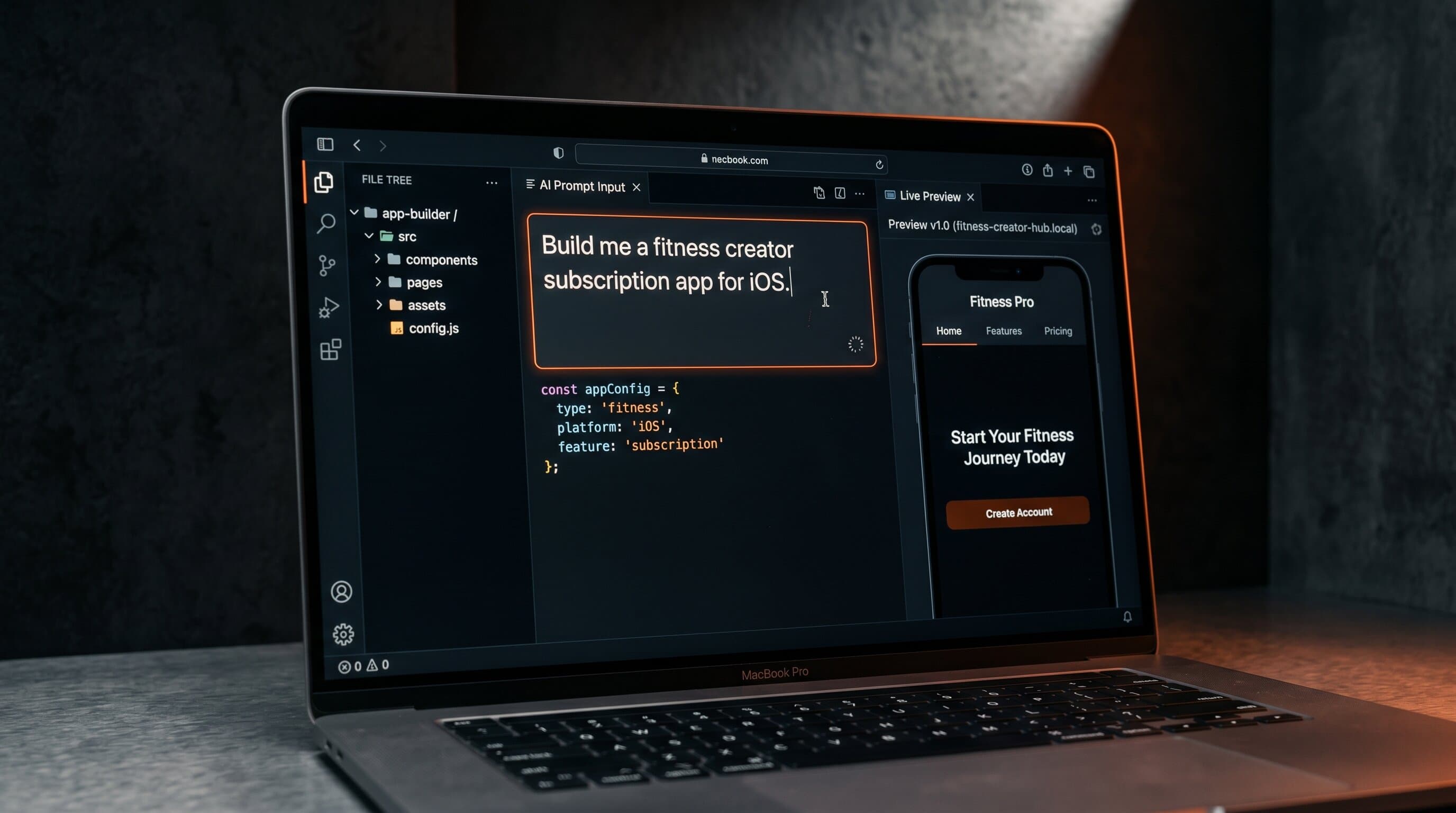
Bolt.new in-browser editor with prompt, code panel, and live preview
Bolt is built around four pieces working together. Prompt to project. You type what you want, the model scaffolds a project (usually React, Next.js, Vue, Svelte, or Astro with Tailwind), and the file tree appears in a panel on the left. Live in-browser preview. Thanks to WebContainers, the project boots as if it were running on a local laptop. You see the actual rendered output, click through routes, and watch state update. Conversational iteration. Every change is a new prompt. "Add a sign-in screen." "Make the hero copy more aggressive." "Wire this form to Supabase." The model edits the codebase and rebuilds. One-click deploy. When you are ready, Bolt deploys to Netlify with a single button. You get a real URL, served on real infrastructure, in roughly the time it takes to refill a coffee. That loop is the magic. Other tools force you to leave the browser. Bolt keeps everything in one tab and feels closer to Figma than to an IDE. Bolt.new uses a token-based pricing model. Every prompt and every code change consumes tokens, and your plan determines how many tokens you get per day and per month.
PlanMonthly PriceBest For
Free$0Trying it out, single small projects
Pro$20Indie builders, side projects
Pro 50$50Multiple active projects
Pro 100$100Heavy daily use, contractors
Pro 200$200Agencies, teams, very heavy use
The token model is the part most creators underestimate. A complex prompt on a large codebase can burn through a meaningful share of a daily allotment in one shot. Bolt is generous with the free tier to get you addicted. Production iteration on a real product moves you to Pro 100 or higher fast. For comparison, that is roughly in line with what Replit charges for its Agent and Core plans and a notch above the entry tier of Lovable. All three sit in the same neighborhood for what you actually use them for. Three things stand out, and they are real. 1. The fastest "from blank screen to working preview" experience in dev tools. Nothing else gets you to a clickable web app this quickly. Not Replit, not Lovable, not a freelance dev, not a side project on your laptop. If you need to test an idea this afternoon, Bolt is the right call. 2. Real in-browser execution. WebContainers means the app actually runs, not just compiles. You can interact, click, fill forms, watch state change. That tight loop teaches you what your idea feels like, which is the part you cannot get from a static mockup. 3. Code you can read and export. The output is not a black box. It is a normal React or Next.js project. You can open it in Cursor, Visual Studio Code, or hand it to a developer. That is a real advantage over no-code tools that trap you inside their proprietary runtime. For a landing page, a waitlist form, an internal dashboard, or a B2B demo, Bolt is genuinely the right tool. We have seen indie hackers ship side projects from Bolt and get to first revenue inside a weekend. The gap between "Bolt is great" and "Bolt is great for creator subscription apps" is where most of the disappointment lives. Five things matter here. No native iOS or Android output. Bolt generates web apps. Period. There is no "ship to App Store" button, no Xcode project, no native iOS binary, no React Native target, no Swift code. If your audience expects an icon on their home screen, Bolt does not put it there. No App Store distribution. The App Store is not a hosting decision, it is a business decision. App Store search, push notifications, In-App Purchase, family sharing, and the recurring trust badge of a real iOS listing are how creator apps grow beyond the original audience. A web app served from Netlify cannot do any of that, no matter how good the code is. No real payments out of the box. Bolt can wire up a Stripe Checkout link. It cannot give you StoreKit, Apple's required payment system for iOS subscriptions. Apple's in-app purchase rules require you to use their system for digital subscriptions inside a native app. Bolt's output sidesteps that entire category. No long-term ownership of the operational layer. When your prompt is your interface, your codebase quietly becomes a slot machine. Every change is a roll of the dice. Six months in, a non-engineer creator has a codebase they cannot maintain, deploy, debug, or scale alone. The same speed that gets you started is what makes you dependent later. No analytics, lifecycle, retention, or growth surface. Real creator apps need event tracking, cohort analysis, push campaigns, paywall experiments, churn dashboards, and App Store Optimization. Bolt does none of that. It hands you a web app on a Netlify URL and waves goodbye. This is the same wall that Lovable hits, and roughly the same wall Replit hits. The category is "vibe coding," and the category cap is the App Store. A creator with 50K plus engaged followers has two growth problems most non-creator founders never face. The first is repeated daily attention. Followers do not check a Netlify URL every morning. They check the home screen of their phone. An app icon is the only digital real estate that compounds without you posting again. The second is reach beyond the existing audience. App Store search, "Top Charts," editorial features, and category browsing are how new fans discover a creator app cold. Tens of millions of people search the App Store every week with commercial intent. A web app gets none of that surface area. This is why our entire model is built around native iOS. We ship every creator a real app with a real listing, ongoing App Care for updates, push, paywall optimization, and store assets. It is also why creators who try to "just use Bolt" usually end up coming back twelve weeks later with a beautiful prototype and no paying users. The three tools are often discussed in the same sentence, but they are not the same product. Here is the honest breakdown.
ToolStrengthPrimary OutputApp Store Ready
Bolt.newFastest in-browser iteration, runs Node in the tabWeb app (React, Next.js, Vue, Astro)No
LovableFriendliest UI, tight Supabase backend integrationWeb app (React, Tailwind, Supabase)No
ReplitReal cloud IDE, broadest language support, agentsWeb app, scripts, bots, side projectsNo
Built by FoundryFounder partner, ships real businessesNative iOS app on the App StoreYes
If you must use one of the three vibe coding tools today, the right choice depends on the job.
  • Pick Bolt.new for the fastest prototype to a public URL.
  • Pick Lovable for the cleanest beginner experience and Supabase wiring.
  • Pick Replit if you need a real cloud IDE and full language coverage.
None of them ship a creator app. That is not a slight against the tools. It is just the category they were built for. Bolt is the right call for:
  • Indie hackers prototyping a web SaaS idea on a Sunday
  • Marketers building a landing page or internal microsite this afternoon
  • Product managers exploring a new feature concept before scoping it with engineering
  • Designers who want a live prototype that actually runs, not just a Figma click-through
  • Founders raising a pre-seed who need a demo on a real URL by Friday
Bolt is the wrong call for:
  • Content creators with 50K plus followers who need a real app to monetize
  • Anyone shipping recurring subscriptions on iOS or Android
  • Anyone planning to use the App Store as a customer acquisition channel
  • Anyone who wants someone else to own the operational tail (App Store updates, push, paywall testing, analytics)
If you are in the second list, you are the audience we built our company for. Bolt is best treated as a sketching tool, not a shipping tool. Use it to prove your idea to yourself in a few hours, then hand the proof to a real product partner who can ship the native version your audience deserves. This is the same pattern we see with creators who eventually build serious app businesses. As we covered in Caroline Girvan's $20M fitness empire, the leap from "content with a paid product" to "real subscription business" only happens when the product lives on phones, not on websites. Web prototypes are step one. Native apps are step ten. For more on what creators actually need, see You Built an Audience. Now Build a Company. and our framework on how creators hit $20K MRR without going viral. No. Bolt.new generates web applications that run in a browser. There is no native iOS output, no Xcode project, and no path to the App Store from Bolt's standard workflow. You can build a mobile-friendly website with Bolt, but a website is not an app. The free tier gives you a daily token allotment that is enough to try the product. Paid plans start at roughly $20 per month and scale up to $200 per month based on how many tokens you need. Heavy iteration on a real product typically moves users to Pro 100 ($100/month) or higher. For raw speed to a working in-browser web app, Bolt.new currently leads. Lovable has the friendliest interface and tightest Supabase integration. Replit has the deepest IDE and the broadest language support. None of the three produce a native iOS or Android app, so for creator apps that need to live on the App Store, all three hit the same ceiling. Bolt can wire up Stripe Checkout for a web app. It cannot integrate StoreKit, which is Apple's required system for subscriptions inside a native iOS app. If you want recurring revenue from an iOS audience, you need a real native app and a real StoreKit integration, neither of which Bolt produces. The deployed web app on Netlify can handle traffic. The harder question is whether you can maintain a vibe-coded codebase as it grows, debug production issues, add features your users request, and run growth experiments. Most non-engineer creators hit a wall around the first real production bug. That is the moment when "fast to build" stops mattering and "easy to run" starts. Bolt.new is a remarkable piece of engineering and one of the best ways to feel an idea in a working prototype this week. It is not the way creators build the next Sweat, Form by Sami Clarke, or CGX. Those are native iOS subscription apps with real distribution, real payments, and a real operating team behind them. If your goal is a sketch, use Bolt. If your goal is a business your audience can pay you for every month, get in touch with the team that builds those for a living. Our model is simple: $0 upfront, three weeks to App Store, and we run the app forever. You can read more about how we work or skip ahead and book a call. Want a real native app instead of a web prototype? We build, launch, and run native iOS subscription apps for creators. $0 upfront. Three weeks to App Store. We handle the tech forever, so you can focus on your audience.
Let's Build →

Creator app strategy

Want us to review your creator business?

Apply for a Foundry Creator App Review. We'll tell you whether there is a real app opportunity hiding in your audience.

Bolt.new Review 2026: Can It Ship a Real App?