
Case Studies & Success Stories

Vishen Lakhiani: $700 to the Mindvalley App

Built by Foundry
July 9, 2026
Share
Vishen Lakhiani: $700 to the Mindvalley App

Get Creator Revenue Insights

How creators are turning audiences into subscription businesses
Share
Key Takeaways:
  • Vishen Lakhiani is a Malaysian entrepreneur and author who turned a personal-growth following into Mindvalley, a subscription learning app
  • He started the company with roughly $700 and grew it into a business he described in interviews as a $40M operation, then larger
  • Mindvalley runs a subscription model: sample classes are free, membership costs around $29/month or $199/year for 100+ programs
  • The app holds a 4.7-star App Store rating, and Mindvalley says it has reached students in more than 80 countries
  • Lakhiani didn't sell one big course. He built a product people renew, and that's the difference between a creator and a founder
Vishen Lakhiani built a personal-growth app that charges people every month whether he films a new video or not. He started with about $700 and a knack for teaching meditation, and turned it into Mindvalley, a subscription app with a library of more than 100 programs. That's the model most creators in the self-improvement space still haven't copied: not a course that sells once, but software that earns on a schedule. Most people with an audience and a method sell an ebook or a $500 program and start over each launch. Lakhiani did the harder, better thing. He packaged the teaching into a product his audience subscribes to, and let the App Store keep it selling for two decades. The gap between those two choices is the entire point of this profile. Vishen Lakhiani is a Malaysian entrepreneur, author, and the founder of Mindvalley. According to Wikipedia, he was born in Kuala Lumpur in 1976, studied computer engineering at the University of Michigan, and moved to Silicon Valley after graduating in 2001. He wasn't a wellness guru by training. He was an engineer. The turn came from burnout. By his own account, the grind of startup life pushed him into meditation, which reshaped how he thought about learning and personal growth. He co-founded Mindvalley in New York City in December 2002 with Michael Reining, then relocated the company to Kuala Lumpur in 2004 after the United States declined to renew his work visa. He also became an author with real reach. His first book, The Code of the Extraordinary Mind, hit No. 10 on the New York Times bestseller list in 2016, and The Buddha and the Badass reached No. 1 on the Wall Street Journal's business hardcover list in 2020. Between the books, the talks, and a following in the millions across his Instagram and Mindvalley's YouTube channel, Lakhiani is the face of the product, which is exactly the growth engine most founders would kill for. He started small and let it compound. In an interview with Mixergy, Lakhiani described building the early company on roughly $700, selling meditation and personal-growth material online before "creator economy" was a phrase anyone used. There was no venture round and no big launch. He sold teaching, reinvested, and kept going. That patience is the whole story. A one-time course would have paid him once. Instead he kept folding the teaching into a growing catalog and eventually a membership, so the same expertise could earn again every month. The business he once described as a $40M company kept expanding from there, all without giving away ownership to investors. What is Mindvalley? Mindvalley is a subscription app for personal growth. One membership unlocks a library of more than 100 structured programs on meditation, health, career, relationships, and mindset, each taught by a specialist instructor, with daily lessons, an AI-guided learning path, and a community of other members. The format is what makes it a business instead of a content dump. Rather than one long course you finish and forget, Mindvalley delivers short daily sessions you return to, which is the behavior that keeps a subscription alive. The app carries a 4.7-star rating on the App Store, and Mindvalley says it has reached students in more than 80 countries.
A glowing smartphone beside a leather journal, pen, and a cup of coffee on a dark desk, representing a daily personal-growth practice
There's a lesson hiding in the structure. Lakhiani could have sold his meditation method as a single $200 program. Instead he built a container that hosts dozens of teachers and renews on its own. Same category, completely different economics. It's the same shift we mapped out in our guide on how to turn a course into a subscription app. Through recurring subscriptions, not one-time sales. Mindvalley uses a freemium funnel: free sample classes pull people in, and a paid membership unlocks the full library. Annual billing lowers the effective monthly price, which nudges casual users toward committing for a year. Here's the rough structure:
PlanPriceBest for
Free classes$0Sampling a few programs
Monthly membership~$29/monthTrying it short-term
Annual membership~$199/yearCommitted daily learners
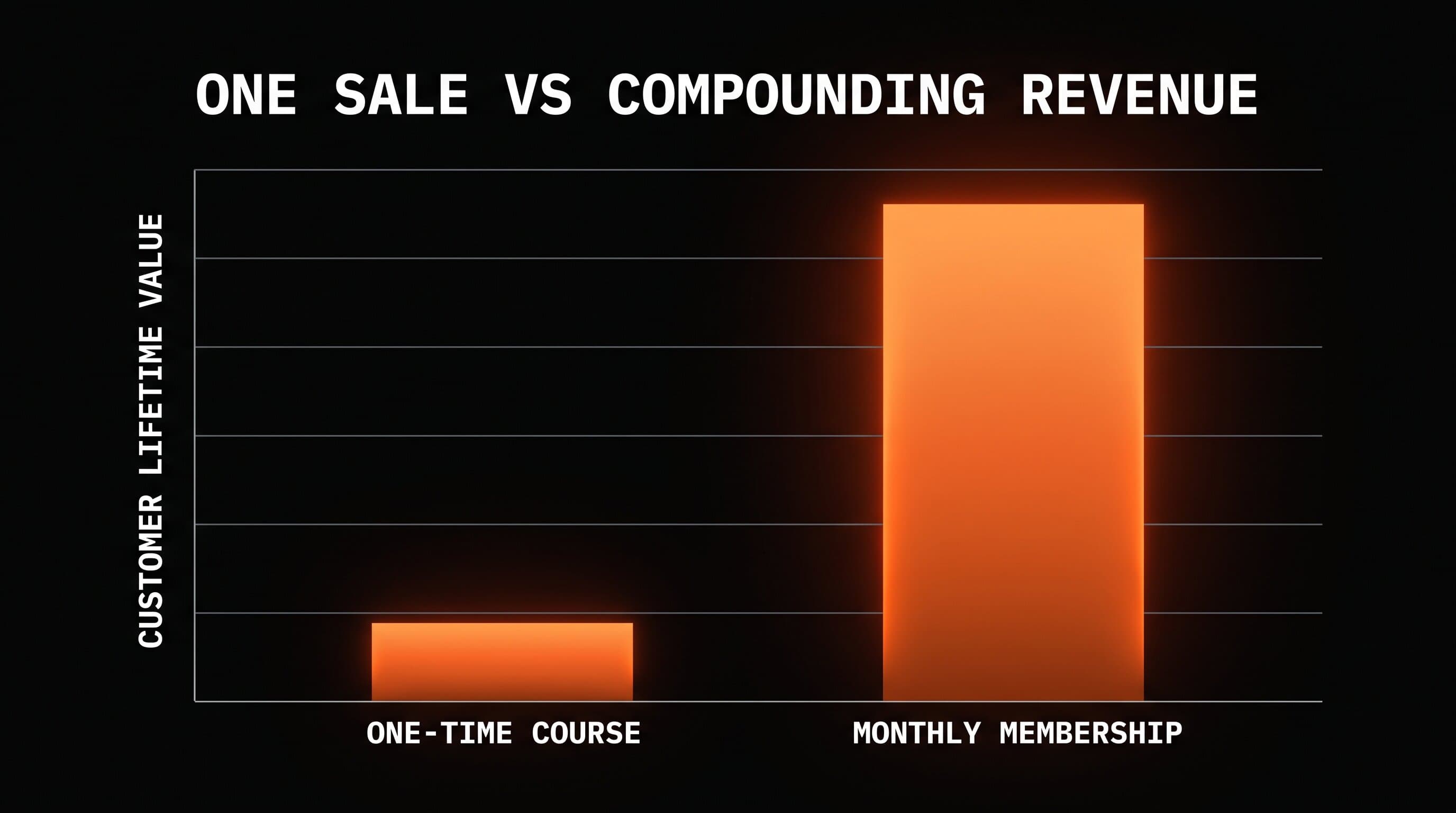
Now compare that to how most self-improvement creators monetize. A one-time program, even a strong one at $299, caps out at $299 per buyer forever. An annual Mindvalley member can pay for years. The lifetime value isn't in the same universe.
Bar chart comparing customer lifetime value of a one-time course versus a monthly membership, with the membership bar towering over the course bar
This is the math that separates a creator from a founder. Tony Robbins ran the same play. He moved from stage seminars to a $99 AI coaching app so his method could sell without him on stage. The medium changes. The logic doesn't: package the expertise, charge on a schedule, and let it compound. Because it turns a personality into an asset. Lakhiani's videos would be worth nothing the day he stopped making them. The app is different. It has a subscriber base, a rating, a catalog, and revenue that exists whether or not he posts. That's the founder's advantage: you build something that keeps earning when you step away. You don't need Lakhiani's bestsellers or his 20-year head start to run this play. You need a method your audience trusts and a product that delivers it daily. Sam Harris did it by turning his podcast into the Waking Up meditation app, a subscription his listeners open every morning. Different teacher, same move: expertise plus software equals recurring revenue. What each of them understood is that the app isn't a side project. It's the business, and the content is the funnel that feeds it. That inversion is the whole mindset shift from creator to founder, and it's the model we build our company around. Three things stand out. First, sell the method, not the moment. Lakhiani didn't monetize a viral clip. He productized a system people use for years. A repeatable daily practice is what makes a subscription worth renewing. Second, let your content do the selling. Every video, book, and talk points back to a product that charges monthly. Your content and your app should feed each other on autopilot, so you're never marketing from scratch. Third, start before you feel ready. Lakhiani built on $700, not a war chest. He didn't wait for a bigger audience or a perfect plan. He shipped and reinvested. The creators who win aren't the ones with the most followers. They're the ones who own a product. Vishen Lakhiani is a Malaysian entrepreneur and author who founded Mindvalley, a subscription app for personal growth. Born in Kuala Lumpur in 1976, he studied computer engineering, worked in Silicon Valley, and built Mindvalley into a global learning platform. He wrote the bestsellers The Code of the Extraordinary Mind and The Buddha and the Badass. Mindvalley is a personal-growth app offering 100+ programs on meditation, health, mindset, and more. It has free sample classes, with paid membership costing around $29/month or $199/year. One membership unlocks the full library plus community and AI-guided learning. Mindvalley makes money through recurring subscriptions rather than one-time course sales. Free classes draw users in, and paid memberships generate monthly recurring revenue that compounds over years, unlike a single program that sells only once. Yes. Built by Foundry builds, launches, and runs custom subscription apps for creators with $0 upfront and a revenue-share model. The creator brings the audience and the expertise; the software gets built and maintained for them. Lakhiani had a method and an audience, and he turned both into a product that's earned for two decades. You have a method and an audience too. The only thing missing is the app. Want to turn your expertise into a subscription app? We build custom apps for creators. $0 upfront, three-week delivery, and we handle every technical piece forever.
Let's Build →

Creator app strategy

Want us to review your creator business?

Apply for a Foundry Creator App Review. We'll tell you whether there is a real app opportunity hiding in your audience.

Vishen Lakhiani: $700 to the Mindvalley App