
Key Takeaways:
- Andrew Huberman launched Huberman Lab in January 2021 from a closet studio — it's now the #1 health podcast on Apple and Spotify
- He earns an estimated $7M+ annually from sponsorships, YouTube AdSense, and premium subscriptions
- Huberman Lab Premium ($10/month via Supercast) launched in October 2022 and raised $500K+ for research in its first year
- His supplement partnership with Momentous helped drive a $32M investment into the company
- He built all of this while staying on faculty at Stanford — proof that expertise-first content compounds
Andrew Huberman recorded his first podcast episode in a closet with his bullmastiff Costello lying on the floor. That was December 2020. Five years later, Huberman Lab is the most-listened-to health and science podcast on the planet — consistently #1 on both Apple Podcasts and Spotify.
He didn't go viral. He didn't pivot from entertainment. He took 20 years of neuroscience research at Stanford and turned it into something people actually use. And then he built a business around it.
Andrew Huberman (YouTube: @hubermanlab, 7.4M subscribers) is a tenured associate professor of neurobiology at Stanford School of Medicine, with a courtesy appointment in Psychiatry and Behavioral Sciences. He earned his PhD in neuroscience from UC Davis in 2004, did postdoctoral work under Ben Barres at Stanford, and joined the faculty in 2016.
His academic work focuses on neural regeneration and brain plasticity. He's published in Nature, Cell, and other top journals. Before the podcast, he was known in academic circles — respected, but not famous.
The podcast changed that. As TIME put it in 2023: "Arguably not since the Fauci mania of the early pandemic has a scientist become as famous, as quickly, as Huberman."
He didn't dumb things down to get there. Huberman Lab episodes run 2-3 hours. They cover dopamine regulation, sleep protocols, cold exposure, light exposure, hormone optimization — dense material delivered with the precision of a lecture and the accessibility of a conversation. Every episode ends with specific, actionable "tools" listeners can implement immediately.
That format — deep science plus practical tools — is why people come back every Monday and Thursday.
How Does Andrew Huberman Make Money?
Huberman's estimated annual revenue exceeds $7 million across multiple streams. Here's where it comes from.
Podcast sponsorships are the largest bucket. His show carries 15+ sponsors including AG1, Eight Sleep, WHOOP, Waking Up, BetterHelp, LMNT, and Function Health. At an estimated CPM of $18-$50 per thousand downloads and 8-12 million monthly downloads, the math adds up fast.
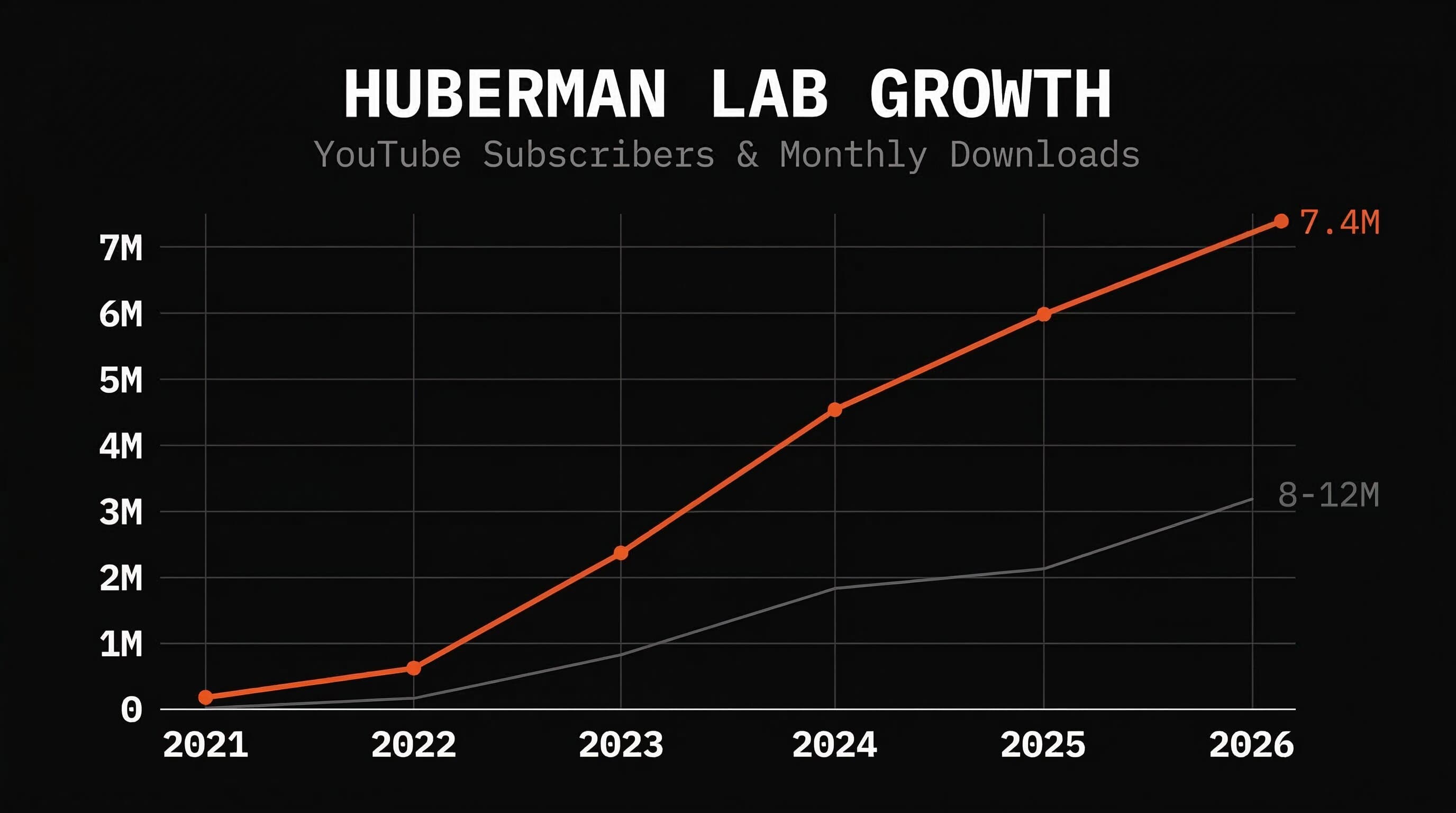
YouTube AdSense from 7.4 million subscribers and ~1.1 million views per episode generates substantial ad revenue — likely $1M+ annually based on his content category and engagement.
Huberman Lab Premium is his subscription product. Launched in October 2022 through Supercast, it costs $10/month or $100/year. Subscribers get exclusive AMA episodes, bonus content, full transcripts, early event access, and the ability to submit questions directly.
Momentous supplement partnership puts his name (and scientific credibility) behind a curated line of single-ingredient supplements. The partnership launched in April 2022, and Huberman joined Momentous's Scientific Advisory Board. In February 2024, Humble Growth acquired a minority stake in Momentous for $32 million — growth driven in part by the Huberman audience pipeline.
Newsletter — "Andrew's Daily Blueprint" reaches 500,000+ email subscribers. Another owned channel. Another way to stay connected without depending on an algorithm.
Talent representation — In May 2024, Huberman signed with WME (William Morris Endeavor) for podcast growth, brand partnerships, and business building.
| Revenue Stream | Type | Est. Annual Revenue |
|---|
| Podcast sponsorships | Per-episode | $3M–$5M+ |
| YouTube AdSense | Per-view | ~$1M+ |
| Huberman Lab Premium | Subscription ($10/mo) | Growing |
| Momentous partnership | Revenue share / equity | Undisclosed |
| Newsletter + events | Mixed | Growing |
The progression is the lesson. He started with free content. Built an audience. Then layered paid products on top — each one creating recurring or compounding revenue.
If you have real expertise and an engaged audience, you can build recurring revenue the same way. Foundry builds, launches, and runs subscription apps for creators — $0 upfront.Book a free strategy call →
What Is Huberman Lab Premium? Why Subscriptions Matter
Huberman Lab Premium launched in October 2022. For $10/month, subscribers get AMA episodes where Huberman answers listener questions in depth, exclusive bonus content, full episode transcripts, and early access to live events.
Two things make this interesting as a business model.
First, the premium tier doesn't cannibalize the free podcast. The core Monday/Thursday episodes remain free and fully available. Premium is additive — it gives superfans more access without locking anyone out. This is the same model we see working across the creator economy: free content builds the audience, paid products monetize the most engaged segment.
Second, Huberman tied Premium to a mission. A portion of proceeds funds human scientific research — not animal models — with dollar-for-dollar matching from the Tiny Foundation (founded by Andrew Wilkinson). In its first year, Premium contributed more than $500,000 to five research projects and student fellowships.
That's the model. Build something people trust. Give them a way to go deeper. Connect the payment to something they believe in. The subscription becomes identity, not expense.
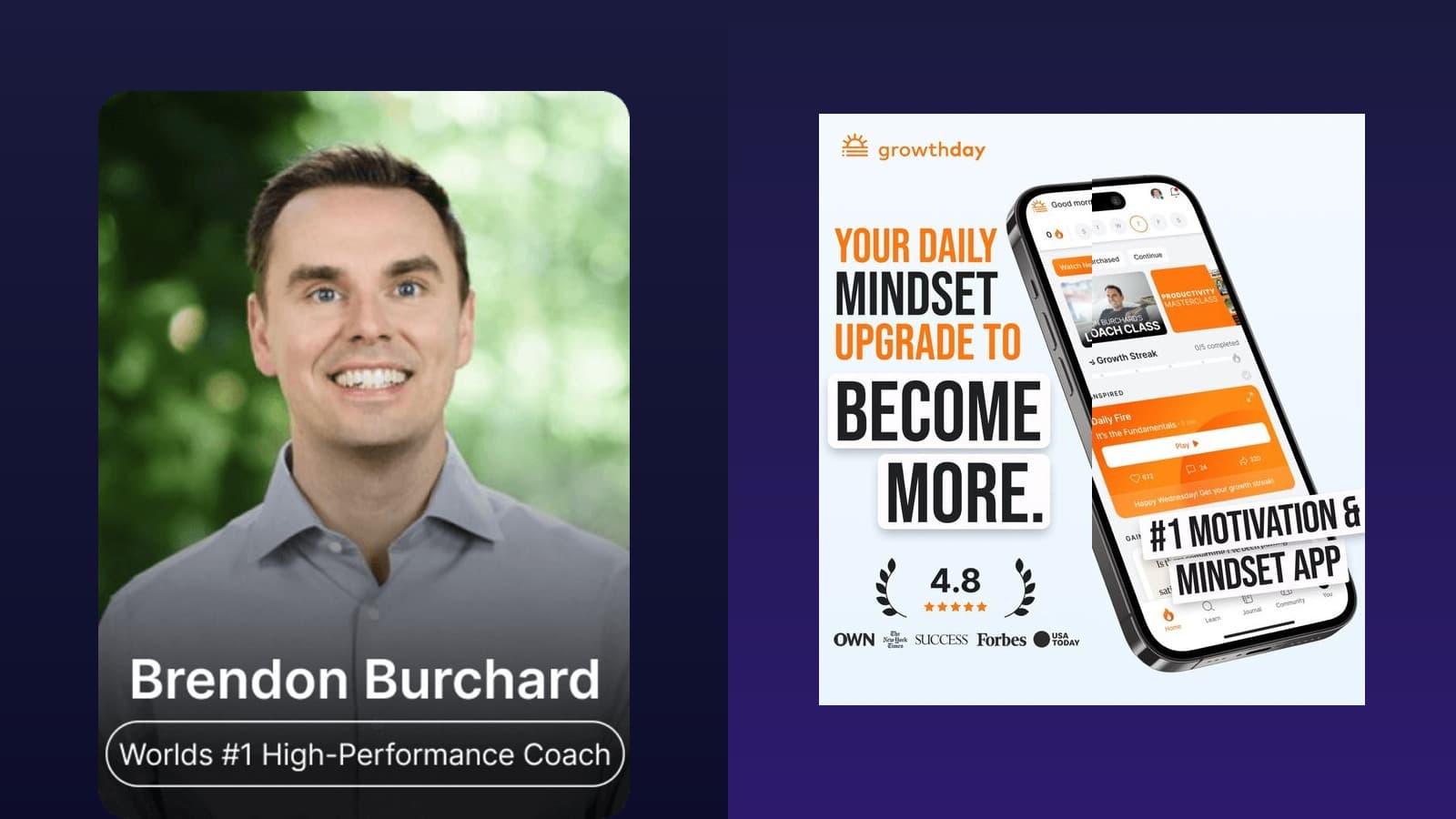
Compare this to what Brendon Burchard built with GrowthDay — a subscription coaching platform that turns expertise into monthly revenue. Different niche, same architecture: free content at the top, subscription product underneath.
How Did Huberman Build a 7M+ YouTube Audience?
Huberman's YouTube channel has 7.4 million subscribers. His Instagram has ~8 million followers. He's on X/Twitter with 1.3 million followers and TikTok with 637,000+.
He didn't grow through shorts, trends, or engagement bait. His growth came from four things:
Depth as differentiation. When every other health creator made 10-minute videos, Huberman made 2-3 hour deep dives. That's counterintuitive — longer content in an attention-deficit market. But it worked because the depth built trust. If someone sits with you for three hours and walks away with actionable tools, they subscribe. They tell their friends.
Consistency over virality. New episodes every Monday and Thursday since January 2021. No breaks. No pivots. No chasing trends. Just the same format, getting better, compounding. Stanford Magazine profiled this consistency as central to what they called "The Huberman Effect."
The "tools" framework. Every episode delivers specific protocols: "Do X for Y minutes at Z time." This turned passive listeners into active practitioners. People didn't just hear about dopamine — they changed their morning routines. That's the difference between content and product. And when your content functions like a product, the audience sticks.
Scientific credibility. He's not a wellness influencer who read a few papers. He's a tenured Stanford neuroscientist with peer-reviewed publications. That matters. The credentials give him permission to go deep where other creators can't.
This is the content-to-business playbook that works across every niche. We've seen it with Kayla Itsines turning Instagram workouts into a $400M app, with Layne Norton building Carbon Diet Coach from his PhD research, and with Ali Abdaal going from study tips to a $10M creator empire. Expertise plus consistency plus owned products.
What Makes the Momentous Partnership Different?
Most creator brand deals are transactional. Record a 60-second ad read, collect a check, move on. Huberman's deal with Momentous is structural.
He joined the Momentous Scientific Advisory Board in April 2022. He helps design the products — single-ingredient supplements that let users build custom stacks based on his podcast protocols. This isn't "use my code for 15% off." It's product development.
The results show. Momentous serves 150+ professional and college sports teams and holds 6 Department of Defense innovation contracts. In February 2024, Humble Growth invested $32 million for a minority stake — a signal that the Huberman audience pipeline is moving real volume.
The lesson for creators: brand deals are renting your audience. Product partnerships — where you shape the product and share in the upside — are building equity. That's the same math we break down in our analysis of brand deals vs subscription revenue.
Your expertise is already a product.
Huberman turned neuroscience protocols into subscriptions and product partnerships. Your knowledge can do the same. We build the app side — $0 upfront, 3-week delivery.Let's talk about your app →
What Does Huberman's Content Machine Look Like?
Huberman and Rob Mohr co-founded Scicomm Media in 2021 to produce the podcast and manage the business. The company operates from a Los Angeles studio — a long way from the original closet.
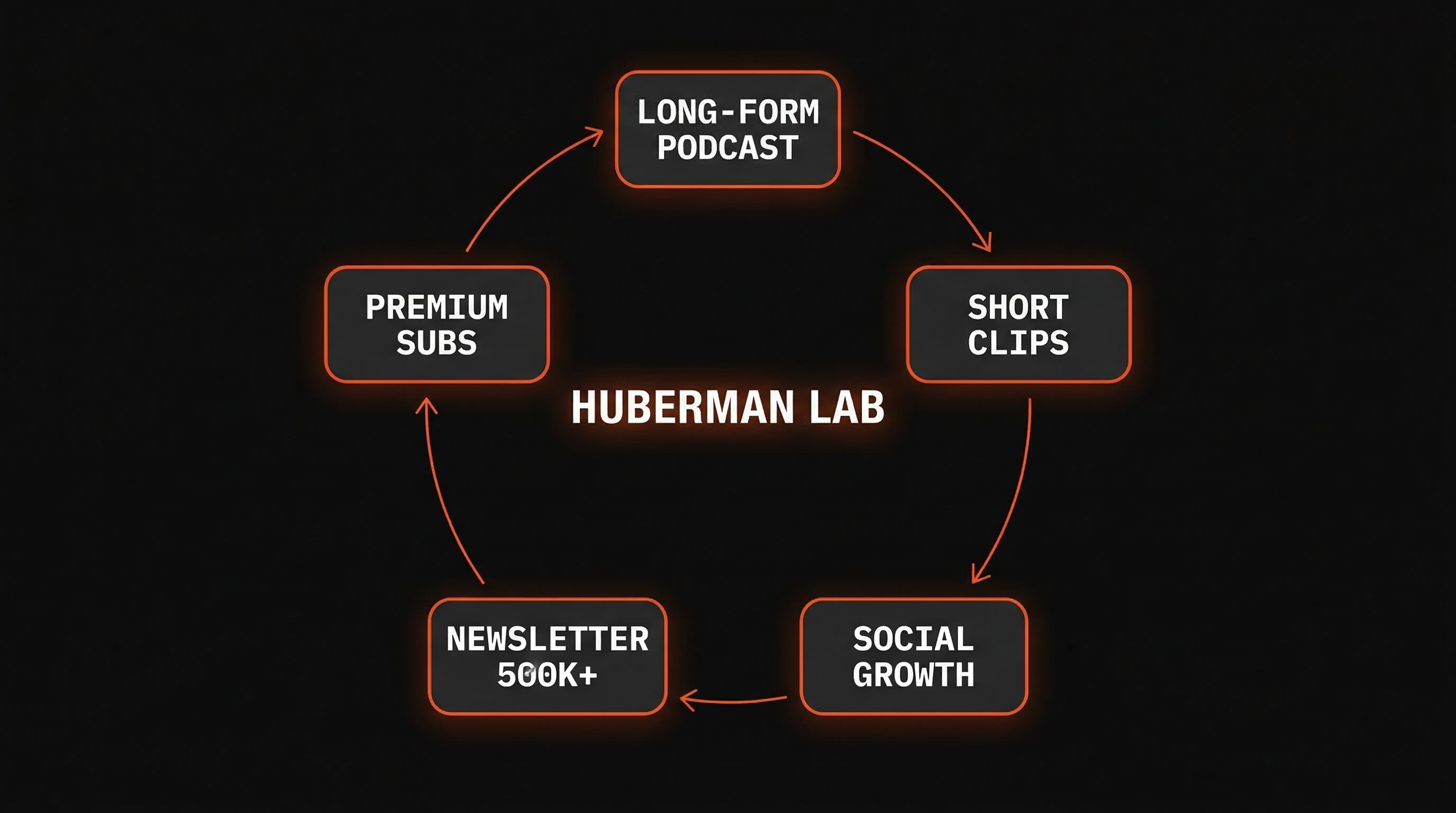
The content operation runs on a clear system:
- Two long-form episodes per week (Monday + Thursday) — each 2-3 hours, deeply researched
- Short clips cut from episodes and distributed across YouTube Shorts, Instagram Reels, and TikTok
- "Andrew's Daily Blueprint" newsletter — daily emails to 500K+ subscribers with protocols and recommendations
- Premium AMA episodes — exclusive subscriber content on a regular schedule
- Guest episodes featuring researchers, physicians, and other experts — each one cross-pollinates audiences
Every long episode generates dozens of clips. Every clip drives traffic back to the full episode. Every full episode drives newsletter signups. Every newsletter drives Premium subscriptions. The flywheel is self-reinforcing.
This is what we mean when we talk about your app becoming a content engine. Huberman doesn't brainstorm what to post — his system generates it. The podcast creates the clips. The clips create the social content. The social content creates new listeners. The listeners create new subscribers.
What Can Creators Learn from Andrew Huberman?
Huberman's trajectory proves something specific: expertise-first content, delivered consistently, beats entertainment in the long run.
He picked depth over breadth. Three-hour episodes in a world of 60-second reels. It filtered for high-intent listeners who become high-value subscribers. When you go deep, you attract people who pay.
He stayed in his lane. Five years of neuroscience protocols. No lifestyle pivots. No "day in my life" vlogs. The discipline to say no to easy content is what made the hard content compound.
He built owned channels. YouTube, the podcast feed, a 500K email list, a premium subscription. He's not dependent on any single platform's algorithm. If Instagram disappeared tomorrow, his business would barely flinch.
He treated partnerships like equity, not ads. The Momentous deal isn't a sponsorship — it's a product collaboration with shared upside. That's a founder move, not a creator move.
He never stopped being a scientist. The Stanford appointment gives him access to primary research, peer review, and academic credibility that no amount of YouTube success can replicate. The credentials aren't decorative — they're the moat.
How Does Huberman's Revenue Compare to Other Creator Models?
| Monetization Model | Huberman's Version | Recurring? | Scalability |
|---|
| Free content | Podcast + YouTube (7.4M subs) | No (ad-supported) | High |
| Sponsorships | 15+ brands per episode | Per-deal | Medium |
| Premium subscription | $10/mo via Supercast | Yes | High |
| Product partnership | Momentous (equity/advisory) | Yes | High |
| Newsletter | 500K+ daily subscribers | Ad-supported | High |
| Events & appearances | WME representation | Per-event | Low |
The mix matters. Sponsorships are his biggest revenue line, but the premium subscription and Momentous partnership are where the compounding happens. A listener who subscribes at $10/month and buys $50/month in supplements is worth $720/year — and they keep paying.
That's the math that separates creators who earn a lot one year from creators who build businesses that earn every year.
Want to build the subscription side of your creator business? Foundry builds, launches, and runs software businesses for creators — $0 upfront, 3-week delivery, we handle everything technical forever.
Huberman built it. Your turn. →
Frequently Asked Questions
How much money does Andrew Huberman make?
Andrew Huberman earns an estimated $7 million or more annually from combined revenue streams including podcast sponsorships (15+ brands), YouTube AdSense from 7.4 million subscribers, Huberman Lab Premium subscriptions ($10/month), the Momentous supplement partnership, and his 500,000+ subscriber newsletter.
What is Huberman Lab Premium?
Huberman Lab Premium is a paid subscription ($10/month or $100/year) launched in October 2022 through Supercast. Subscribers get exclusive AMA episodes, bonus content, full episode transcripts, early access to live events, and the ability to submit questions directly to Dr. Huberman. A portion of proceeds funds human scientific research with dollar-for-dollar matching from the Tiny Foundation.
How many subscribers does Andrew Huberman have?
Andrew Huberman has approximately 7.4 million YouTube subscribers, 8 million Instagram followers, 1.3 million X/Twitter followers, and 637,000+ TikTok followers. His email newsletter "Andrew's Daily Blueprint" reaches 500,000+ subscribers.
Does Andrew Huberman have an app?
Andrew Huberman does not have his own branded mobile app. His subscription product runs through Supercast on the web. He is associated with Reveri (a self-hypnosis app co-created by his Stanford colleague David Spiegel) and Virtusan (which features his Physiological Sigh breathing protocol), but neither is his own product.
Is Andrew Huberman still a professor at Stanford?
Yes. Andrew Huberman is a tenured associate professor of neurobiology at Stanford School of Medicine, with a courtesy appointment in Psychiatry and Behavioral Sciences. He maintains his academic position while running Scicomm Media and the Huberman Lab podcast.