
5 Discord Alternatives for Creators in 2026

5 Discord Alternatives for Creators in 2026

Foundry
May 9, 2026
Key Takeaways:
  • Discord has 200M+ monthly users and is the default creator community tool, but it was built for gamers chatting, not creators billing. There is no native subscription engine, no App Store distribution, and the audience belongs to Discord.
  • Skool ($99/mo flat) bundles community plus courses and added Alex Hormozi as a backer in 2024, making it the fastest-growing Discord alternative for creators selling knowledge.
  • Circle ($89 to $399+/mo) is the polished SaaS option for paid memberships, used by Adam Grant and Pat Flynn, with cleaner UX and built-in payments.
  • Geneva (free) is the closest emotional match to Discord with channels, voice rooms, and a mobile-first feel, but it has no native paid tiers.
  • Mighty Networks (starts at $39/mo) is the all-in-one for creators who want courses, community, events, and paid tiers in one container.
  • The honest fifth alternative is the one most creators skip: stop renting community real estate and ship your own subscription app on the App Store. Discord retention dies the moment a creator stops posting. App retention runs on push notifications and habit.
Looking for Discord alternatives? You are in the right place. Discord became the default creator community for one reason. It is free, fast, and your audience already has it open. That convenience is a trap. Discord was designed for gamers running raids in 2015, not creators running businesses in 2026. The platform makes it easy to start a server and almost impossible to turn that server into recurring revenue you actually own. Below are the five Discord alternatives worth considering, what each is good at, where each falls short, and the move most creators do not even put on the whiteboard: building their own subscription app where the community lives inside a product they own. Direct answer: Discord is a community tool, not a business tool. There is no subscription engine, no App Store visibility, no real CRM, and the audience relationship belongs to Discord. Creators who treat a Discord server as their business find out the hard way when it stops paying them. Discord's own Server Subscriptions feature exists, but it is restricted to a fraction of servers, payouts are slow, and the take rate plus payment fees stack up. The bigger issue is structural, not financial. When a fan joins a Discord server, they install Discord. They get notifications from Discord. They scroll Discord's feed of other servers. They are one accidental click away from a competing creator's server in their sidebar. The relationship is mediated end to end by software you do not own. If Discord changes a rule, you find out the same day your audience does. Discord raised $500M in 2021 at a $15 billion valuation according to TechCrunch. That valuation is not built on creator revenue. It is built on capturing time. Your community is the inventory. There is also the search problem. Conversations inside a Discord server do not rank on Google. They are not indexed. Five years of question and answer threads in your server build zero SEO equity for you. Compare that to a community on a platform with public pages, or better, an app with a real App Store listing that gets discovered by people who never followed you. Before the deep dives, here is the comparison.
PlatformPricingNative paid tiersBest forKey limitation
DiscordFreeLimited (Server Subs only)Gaming, casual fan groupsNo real revenue engine, no App Store, no SEO
Skool$99/mo flatYesCreators selling courses plus communityOne template, gamification can feel cheesy
Circle$89 to $399+/moYesPremium memberships with polishHigher learning curve, more buttons
GenevaFreeNoMobile-first community feelNo subscription engine, monetization is manual
Mighty Networks$39 to $179+/moYesCreators wanting courses, events, and tiers in one placeJack of all trades, master of none
Your own app (Foundry)$0 upfront, revenue shareYes (App Store + Stripe)Creators with 50K+ engaged followersBest when content has a daily-use behavior
Now the breakdowns.
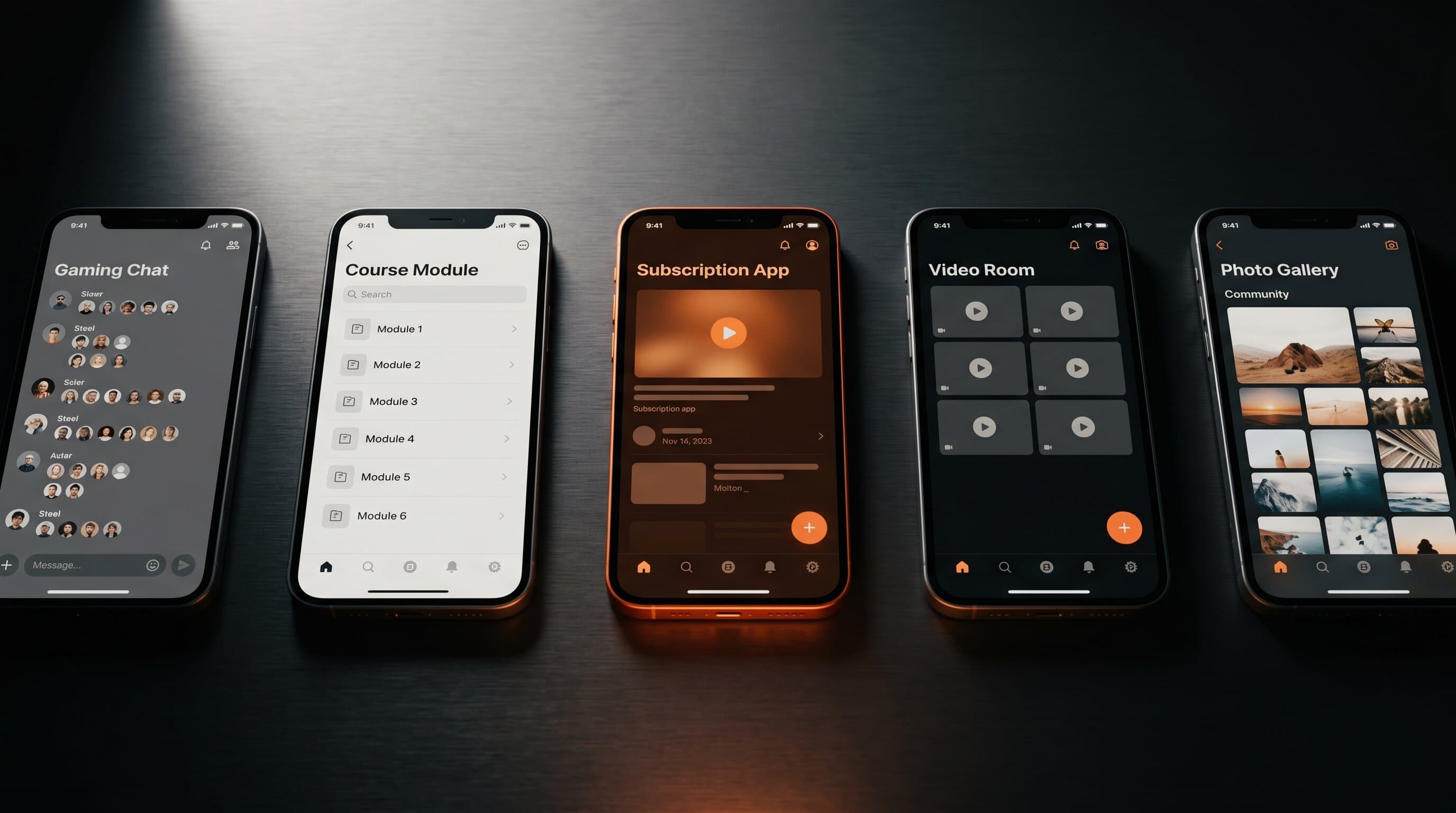
Foundry-style flat lay showing five community platform logos arranged on a dark surface with warm orange accent lighting
Skool was founded by Sam Ovens in 2019 and quietly grew until 2024, when Alex Hormozi made a public investment and started using Skool as the central case study in his content. Hormozi's involvement is covered in Forbes coverage of his Acquisition.com playbook. Since then, Skool has become the most-mentioned Discord alternative in creator circles. Pricing: $99 per month flat. No tiers, no per-member fees, no transaction take. Add unlimited members and unlimited paid groups. Why creators move: The core insight is that creators selling knowledge do not just want chat. They want chat plus courses plus a leaderboard plus a paywall, all in one container. Skool delivers exactly that. Members get gamification points for posting and completing course modules. The leaderboard becomes a content feed of fan wins. Stripe is one click. The flat $99 makes the math obvious. Where it falls short: Skool gives you one template. Creators who want a custom feel run into walls. The gamification can feel cheesy on a premium membership. Members are still hosted on skool.com, not your domain, and the mobile app is Skool's, not yours. Who should switch: Creators selling courses and coaching who want community to be part of the bundle, not a separate Discord server they manage in parallel. We compared the bigger trade-offs in our Skool review. Circle.so was founded by Andrew Guttormsen and Sid Yadav, both early Teachable employees, and the platform reads like Teachable for community. It is the option creators pick when they want a paid membership that does not look like a Discord screenshot. Pricing: $89 per month for the basic plan, $199 per month for Plus, and $399+ for Business with branded apps and white-glove support. Why creators move: Circle nailed the things Discord ignored. Paid memberships work natively. Members log in to your branded URL. Spaces let you organize content cleanly: a feed for posts, a feed for events, a feed for paid-only content. Live streaming, courses, and gated paywalls all live inside one product. Adam Grant, Pat Flynn, and the On Deck communities have all run programs on Circle. Where it falls short: Circle is a SaaS first and a community second. The settings panel can feel heavy. Pricing climbs fast once you want a branded mobile app, which is the feature creators care about most. There is no App Store distribution unless you pay for the highest tier and then it is a wrapper, not a real app product. Who should switch: Creators with a paid program north of $50/month who want the membership to feel premium. The polish is the product. Geneva was launched in 2020 and built for the iPhone first. It is the closest emotional match to Discord. Channels, voice rooms, group chat, photo galleries, all wrapped in a softer, less gamer-coded UI. Geneva's own product positioning is "private group chat for the things you love," which is exactly the same job Discord does, minus the Nitro upsells. Pricing: Free for the host and members. Why creators move: It is calmer than Discord. The interface is built for adults, not teenagers running gaming raids. The mobile app is genuinely good. For creators whose audience skews 25 to 45 and feels alienated by Discord's vibe, Geneva is an easy switch. Where it falls short: There is no native paid tier, no Stripe integration, no leaderboard, no course tooling. If you want money to move, you have to bolt on a separate tool. Geneva is great for a free fan group, not a business. Who should switch: Creators running a free community as a top-of-funnel or fan space who want a less chaotic feel than Discord. Treat it as a community layer, not a revenue layer. Mighty Networks was founded by Gina Bianchini, the former CEO of Ning, and the platform has been building toward "everything for creators in one place" for nearly a decade. Members, courses, events, paid tiers, chat, and now AI features all live under one roof. Pricing: Community plan at $39 per month, Business plan at $119, and Path-to-Pro at $179+. There are also custom Mighty Pro plans for creators who want a fully branded app, which can run into five figures per year. Why creators move: The bundle is the value. Instead of running Discord plus Teachable plus Stripe plus Calendly, you run one Mighty Network. For a creator launching a paid community for the first time, that consolidation is real. Where it falls short: Doing many things means doing few things great. The course experience is not as smooth as Skool's. The community feel is not as alive as Geneva's. The branded app upsell is the only path to App Store presence and it is expensive. We covered the wider tradeoffs in 5 Mighty Networks alternatives for creators in 2026. Who should switch: Established creators with multiple revenue streams who want to consolidate, and who are comfortable trading specialization for one bill.
A single iPhone showing a creator app interface on a dark surface with a single warm orange rim light along the device edge
Here is the option none of the platforms above will tell you about. Stop renting community real estate. Ship a subscription app you own. A creator app is not a Discord server with a paywall. It is a product on the App Store, with push notifications, a real onboarding flow, and a subscription billed through Apple or Stripe. It does three things Discord, Skool, Circle, Geneva, and Mighty cannot do at the same time. One. The App Store distributes for you. Roughly half of new app installs come from App Store search according to Apple's developer documentation on App Store discovery. That means people who never followed you on Instagram or YouTube can find your app while searching for the problem you solve. Your follower count is no longer the ceiling. Two. The product generates content for you. Every user submission, leaderboard, milestone, before-and-after, and completed program is a piece of content the app produces on autopilot. The creator's job shifts from inventing content from nothing every morning to highlighting what their app is already doing. We unpack that loop in the brand deal vs MRR math problem. Three. Push notifications run retention. Discord has notifications. Discord does not have YOU as the brand owning that notification channel. When your app sends a daily streak reminder, that is a brand impression in your name, on your icon, on the lock screen. Discord retention dies the day a creator stops posting. App retention runs on the habit you built into the product. The reason creators do not pick this option is the same reason they pick Discord in the first place. It feels expensive and slow. The math is the opposite. A 50K-engaged-follower creator with a $14.99 a month app and a 3 percent conversion lands at roughly $22K MRR. That is one Discord server's worth of community converted into a real business. If you want to understand how the operational side actually works, our /about page covers the model and our /app-care page covers what running an app forever looks like, since shipping is not the hard part. Operating is. The honest version of this comparison is not "which platform has nicer channels." It is "which platform earns the creator the most money over five years."
PlatformYear 1 setup costTake rateOwns the audienceApp Store presence
DiscordFreeVariable, cappedNoNone
Skool$1,1880%PartialNone
Circle$1,068 to $4,7880%YesLimited (Business plan only)
GenevaFreeManualNoNone
Mighty Networks$468 to $2,1480%YesMighty Pro tier only, expensive
Your own app (Foundry)$0 upfrontRevenue shareYesFull App Store and Google Play
Free is not the same as cheap. A free Discord that earns nothing for three years is more expensive than a paid platform that earns $20K MRR by month nine. Time is the asset that gets destroyed when creators pick the easiest tool instead of the right one. Three reasons keep coming up in conversations. Burnout from being the algorithm. A Discord server only has signal when the creator posts. The moment they stop, the channels die. That is identical to the social media treadmill the creator was trying to escape. Subscription apps invert this. The product runs the engagement. No revenue lever. Even creators with thriving free Discords cannot find a clean upgrade path to monthly revenue. Server Subscriptions are throttled and clunky. Bolt-on tools like Whop or Patreon split the audience across two places. The community is alive, the bank account is not. We covered the broader pattern in why creators are leaving Patreon for apps in 2026. Competitor proximity. Every Discord server lives next to every other Discord server. The mute, leave, and join buttons are the same gesture. The friction to switch is roughly zero, and creators feel it. An app is the opposite. Once it is on a fan's home screen, it is the most permanent piece of brand real estate a creator can own. Discord is not a bad tool. It is a bad business model. If you love the chaos of your server, keep it. Make it the free top of your funnel. Use one of the alternatives above as the paid layer. The two-tier setup most creator businesses end up with looks like this.
LayerPurposeTool
FreeTop of funnel, casual fans, daily chatDiscord or Geneva
PaidRecurring revenue, deeper product, daily useYour own subscription app
The mistake is collapsing both layers into Discord and calling it a business. The fix is admitting Discord is the lobby and your app is the building. Discord is good for community. It is not good for monetization. Server Subscriptions exist but are limited to eligible servers, take a meaningful cut, and the broader product is not designed to sell. Most creators earning from a Discord audience are doing it through tools bolted on top, not through Discord itself. For most creators, Skool ($99 flat per month) and Circle ($89 to $399+ per month) are the two strongest pure paid-community options. Skool wins on simplicity and pricing. Circle wins on polish and customization. The strongest long-term option is a creator-owned subscription app that uses one of these as the community layer or replaces it entirely. Yes, but only one fan at a time. Discord does not let you export emails or contact info, so the migration runs through your own owned channels. Most creators announce the move on Instagram, YouTube, and email, then incentivize the first 1,000 movers with a launch price or founding-member benefit. Plan for 30 to 60 days of overlap. Most agencies quote $50K to $250K and a six to twelve month timeline. Built by Foundry charges $0 upfront and ships in three weeks. We take a revenue share, so we earn when the creator earns. Our /about page covers the model in detail. Most creators keep it as the free top of their funnel. The paid app becomes the home for the deeper product. New fans land in Discord. The most engaged fans graduate to the app. The creator stops trying to monetize Discord directly and treats the server as marketing, not revenue.
Want to turn your community into recurring revenue? We build custom subscription apps for creators. $0 upfront. Three weeks to App Store. We handle all the tech forever.
Let's Build →

Get Creator Revenue Insights

How creators are turning audiences into subscription businesses

You might also enjoy...

5 Discord Alternatives for Creators in 2026