
Key Takeaways:
- Audience demand signals — repeated questions, DMs, comments — are the most reliable indicator you're ready
- You don't need a million followers; you need the right 50K who already spend money on your niche
- If brand deals feel like a ceiling, that's not a feeling — it's data about your income trajectory
- Creators who can describe their app in one sentence are 3x more likely to ship and succeed
- The question isn't "am I ready?" — it's "how much longer can I afford to wait?"
Most creators wait too long. They keep posting. They keep growing. They keep landing brand deals and wondering why the number in their bank account never quite matches the number in their follower count.
There's a specific moment when a creator stops being a content business and becomes a product business. It doesn't require a team, a co-founder, or even a clear roadmap. It requires recognizing the signals that are already sitting in your analytics, your DMs, and your gut.
Here are nine of those signals. If you recognize most of them, you're not almost ready — you're already late.
Sign 1: Your Audience Keeps Asking the Same Question
Not a question. The same question. The one that shows up in your comments, in your DMs, in your YouTube replies at a rate you can't ignore.
"What program do you use for this?" "What do I eat the day before a long run?" "How do I structure my week if I'm just starting out?"
When you see the same question repeat across platforms, you're not looking at curiosity. You're looking at unmet demand. Your audience has already told you what they want — they want your answer, structured, accessible, and on-demand.
That's an app.
Jeff Nippard spent years answering evidence-based nutrition questions in comments before his team built MacroFactor — a nutrition tracking app that now has tens of thousands of paying subscribers. The demand wasn't manufactured. It was already there.
Sign 2: Have You Already Sold Something?
If you've run a paid challenge, sold a PDF guide, launched a course, or had a merch drop that sold out — you've already answered the hardest question in the creator business: will my audience pay me for something?
Most creators underestimate what this proves. A paid challenge with 500 participants at $49 each isn't a small thing. That's $24,500 in revenue and 500 people who raised their hand and said "I trust you enough to pay you." That's a launch list.
The move from a paid challenge to a subscription app isn't a leap. It's a logical next step. You're taking something people already pay for once and making it available consistently, at a lower monthly price, with a better experience.
If you've sold anything — even once — you've validated the business model. Now the question is scale.
You've already validated the demand — let's build the product.
Software People Love builds creator apps for $0 upfront. We handle all the technical work and take a revenue share. You bring the audience; we'll build the business.Book a free strategy call →
Sign 3: Your Engagement Rate Outpaces Your Monetization
Here's a number most creators don't calculate: revenue per engaged follower.
If you have 200K followers, a 4% engagement rate (8,000 engaged people per post), and your best month from brand deals and merch was $12,000 — that's $1.50 per engaged follower per year. That's low. Genuinely low.
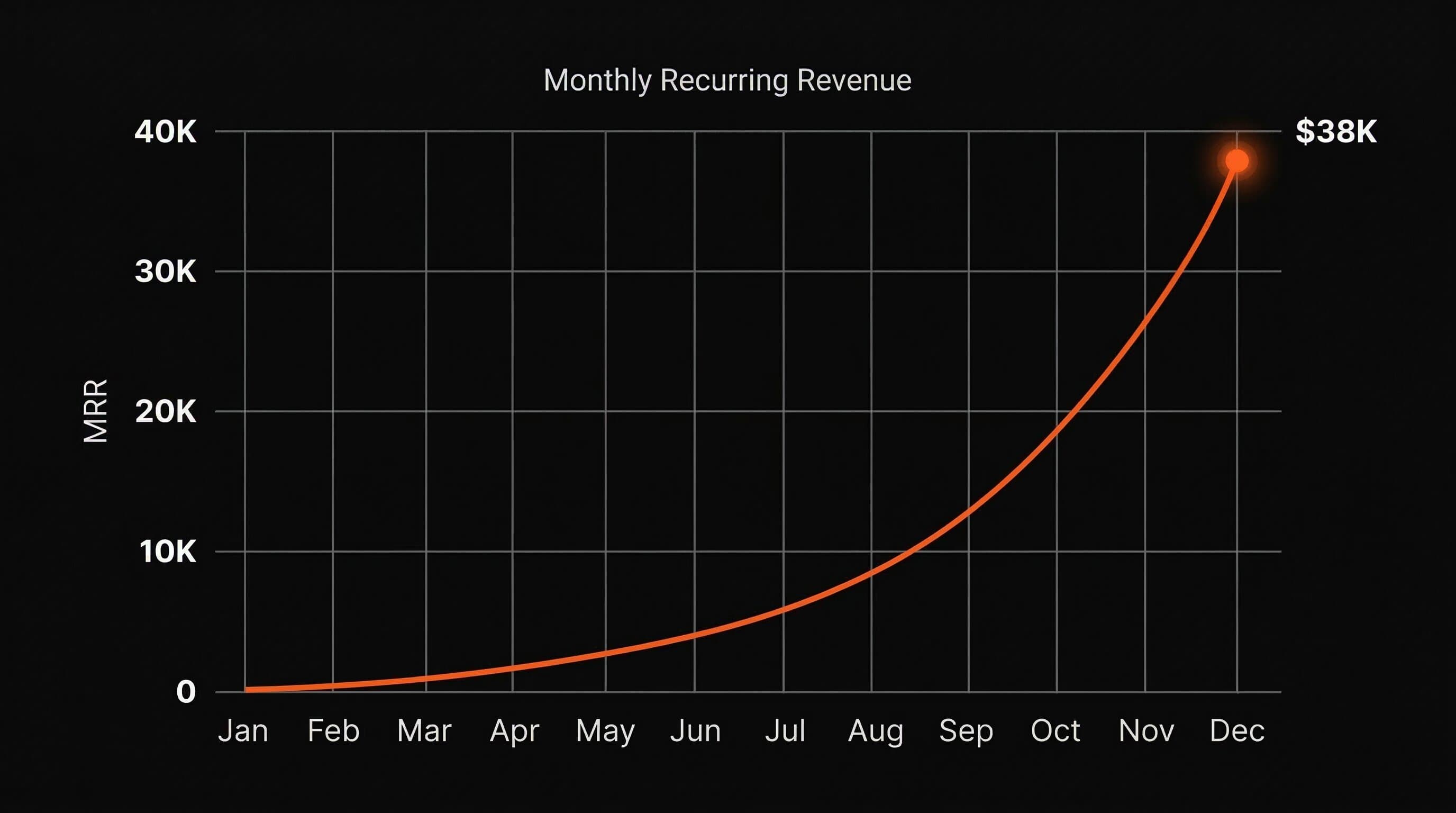
Compare that to a subscription app with 3,000 subscribers at $12.99/month. That's $39K/month MRR from 3,000 people — a fraction of your 8,000 engaged fans. The math only works because apps convert engagement into recurring revenue instead of one-time payouts.
As we've written about before, the size of your audience matters far less than the depth of their engagement. A creator with 60K followers and a 7% engagement rate can build a more durable business than one with 2M followers and 0.4% engagement.
If your engagement is high and your revenue doesn't match it, you're leaving your most valuable asset underused.
Sign 4: Do You Have 50K+ Followers Who Actually Buy?
The threshold most people cite is 1 million followers. Ignore it.
The actual number that matters is 50,000 engaged followers in a niche where people spend money. Fitness. Finance. Language learning. Productivity. Cooking. Golf. Photography. If your audience buys things related to your niche — gear, supplements, courses, coaching — you have a buying audience.
Kayla Itsines had around 200K Instagram followers when she launched the Sweat app. She didn't wait for 1 million. She launched to the audience she had, validated the model, and scaled from there. Sweat eventually sold for $400 million. The audience size at launch wasn't 1M — the willingness to buy was.
The question isn't "do I have enough followers?" It's "do the followers I have spend money in my niche?"
If the answer is yes, 50K is plenty to start.
Sign 5: Can You Describe Your App in One Sentence?
This one's a filter, not an achievement.
If you can't describe what your app does in one sentence, you don't have an app idea yet — you have a collection of features that haven't been organized into a product. That's fine. But build the sentence before you build anything else.
The sentence should follow a simple structure: "My app helps [specific person] do [specific outcome] by [specific mechanism]."
"My app helps beginner runners finish their first 5K in 8 weeks using structured audio coaching." That's a product. "My app is kind of like a fitness thing where I share my workouts and nutrition and some motivational content" — that's not.
Kayla's pitch was essentially: "My app gives women a 12-week guided workout program they can do anywhere." Specific person, specific outcome, specific delivery. One sentence.
If you can write that sentence cleanly, you're ready to build. If you can't write it yet, that's the only thing to work on before anything else.
Sign 6: Brand Deals Feel Like a Ceiling
There's a specific kind of frustration that comes from brand deals, and it's not about the money. It's about the math.
Brand deals pay you once per campaign. An audience of 300K might earn you $8K-$15K per integration, a few times a month if you're lucky. That's real money. But it doesn't compound. You earn it, you spend it, and next month you start over.
Subscription apps compound. 1,000 subscribers at $14.99/month is $14,990 in January. If you retain 95% of them in February and add 200 more, you have $16,340. March, same thing. The number goes up without you doing another campaign.
The math between brand deals and subscription apps isn't even close. But the creators who feel it most clearly are the ones who've been doing brand deals long enough to realize the ceiling is real — and it's lower than they want.
If you've looked at your brand deal income and thought "this can't be the whole model," that's not imposter syndrome. That's pattern recognition.
Joe Wicks built The Body Coach app after years of brand partnerships and free content. The reason wasn't that brand deals stopped working — it was that app revenue doesn't require him to post every day to maintain it.
Sign 7: Your Content Has a Repeating Structure
This one is underrated.
If your content has a pattern — a structure that repeats week over week — that structure is the skeleton of your app. You've already done the product design work without realizing it.
Weekly program creators: your app is a structured progression with a calendar. Daily routine creators: your app is a habit system with check-ins. Recipe creators: your app is a meal plan generator with a shopping list. Language teachers: your app is a daily lesson sequence with spaced repetition.
Pamela Reif built her Pam app around the exact same structured workout format she'd been posting on YouTube for years. Same calendar logic, same exercise sequencing, same progression philosophy — just inside an app where people pay monthly and get more of it.
The content you already make is a proof of concept. If it has a repeating structure your audience follows, you have an app waiting to be built.
Your content structure is already your product blueprint.
We help creators turn their existing content format into a subscription app — without you having to learn to code or manage developers. Find out if your format qualifies.Talk to us about your content format →
Sign 8: You've Thought 'Someone Should Build This'
Pay attention to that thought.
When you're using a generic fitness app and thinking "this doesn't account for [your specific method]" — that's a product insight. When you're scrolling through recipe apps and thinking "none of these are built around how I cook" — that's a market gap. When you're recommending a patchwork of three different apps to your audience because nothing does exactly what you teach — that's the brief.
Creators who build the best apps aren't the ones who hired a development team and asked them to invent something. They're the ones who were frustrated by what existed and built the thing they wished was there.
That frustration is due diligence. It means you've thought deeply enough about the problem to know what's missing. Most entrepreneurs spend months on market research to arrive at the same place you reached by living in your niche.
If you've ever been annoyed that no app does what you do, or recommended a workaround to your audience because the right tool doesn't exist yet — build the right tool.
Sign 9: Is the Algorithm Controlling Your Income?
Here's the real question underneath all the others.
If Instagram changes its reach algorithm tomorrow and your posts start getting 40% less visibility — what happens to your income? If YouTube adjusts its ad revenue split or changes how it surfaces subscribers' notifications — does your business survive?
For most creators, the honest answer is: not without a painful few months of scrambling.
Platform dependency is the most underrated risk in the creator economy. You can have 500K followers and zero control over how many of them see your content. You can have five years of audience-building invested in a platform that can change its rules overnight.
An app breaks that dependency. Your subscribers are your subscribers — not TikTok's users that TikTok is letting you borrow. They pay you directly. You have their email. You control the relationship.
The difference between renting an audience on a platform and owning one through a subscription product is the difference between a job and a business. One of them you can sell.
That's the real sign you're ready: when you realize you're building on rented land, and you're tired of paying rent.
What Happens After You Recognize the Signs?
Most creators who read a list like this one nod along and then do nothing. Not because they don't believe it — because the next step feels unclear.
Here's what the next step actually looks like: six concrete phases from validating your app idea to launching a subscription product. None of them require a technical background. All of them start with the audience you already have.
The creators who move fastest are the ones who don't try to figure out the technical side themselves — they find a partner who's done it before and handles the build, the App Store submission, and the ongoing maintenance.
At Software People Love, that's the model: $0 upfront, we build the product, and we take a revenue share. We only win when your business wins. It's the alignment that makes the partnership work — and the reason we're selective about who we work with.
If you recognized yourself in 5 or more of these signs, the question isn't whether you're ready. It's what you're waiting for.
Frequently Asked Questions
How many followers do you need to launch a creator app?
There's no universal minimum, but 50,000 engaged followers in a niche where people spend money is a workable starting point. Engagement quality matters more than raw count — a creator with 60,000 highly engaged followers in fitness, finance, or language learning has a better foundation than one with 500,000 passive followers in a broad entertainment niche. Creators have successfully launched subscription apps at 30,000 followers when the engagement and niche alignment were strong.
How much does it cost to build a creator app?
Traditional development agencies charge $25,000–$150,000 upfront for a custom app, depending on complexity. Revenue share models — where the development partner takes a percentage of subscription revenue instead of upfront payment — eliminate the initial cost entirely. Most production-ready creator apps (subscription system, onboarding, core content delivery, App Store submission) fall in the 8–14 week build range regardless of which payment model you use.
How long does it take to build a creator app?
A focused MVP creator app — one with a clear core feature, subscription billing, and a working onboarding flow — takes 8 to 12 weeks from kickoff to App Store submission. More complex apps with custom AI features, multi-format content, or community layers take 4 to 6 months. The biggest variable is how clearly the creator can define what the app does before the build starts. A one-sentence product brief usually cuts 3–4 weeks off the scoping phase alone.
What kind of app should a creator build?
The best creator apps solve one specific problem for one specific type of person. Fitness creators build structured workout programs. Nutrition creators build meal planning and tracking tools. Language teachers build daily lesson and vocabulary systems. Finance creators build budgeting frameworks. The common thread is a repeating content structure the audience already follows — the app formalizes that structure into a paid product. If you have a method or system your audience refers back to consistently, that's the starting point.
You've already built the audience. Now build something they can pay for every month.
Book Your Free Strategy Call →